photo Image277_1x1_zps92a4c832.gif photo Image277_1x2_zps82501ae2.gif photo Image277_1x3_zpse2f7619b.gif photo Image277_1x4_zpsbfd3d820.gif photo Image277_1x5_zps55244bd5.gif photo Image277_1x6_zpsa94012cf.gif
Showing posts with label parent communication. Show all posts

Thursday, October 17, 2013

Teaching Fluency with Fluency Folders

Teaching fluency is so important for reading teachers, but in recent years, DIBELS and AIMSweb have put such a heavy focus that it sometimes confuses students.

We’ve all seen that kid who sits down to a fluency diagnostic and speeds through way too fast, getting a high score on the assessment but not showing good reading skills in the slightest! I’m sure we can all agree…

IMG_1009-001

I think all these assessments are giving fluency a bad rap. It really IS important for our kids to be able to read fluently, and fluency diagnostics are used so often because, honestly, most kids who can read fluently (truly fluently, not just fast) really are better readers.

We just have to make sure that fluency in our classrooms means more than JUST a fast pace! I like to teach it as the right “PASE” instead. I like to break fluency into four parts: Pausing, Accuracy, Speed, and Expression! YES, speed is part of it- but no, it’s not everything!

The description of fluent reading that resonates the most with my students is “not reading like a robot,” but reading the same way we talk. I think modeling great fluency is the best thing we can do to teach it, but I also think we need to point out to our students what we are modeling. I teach each element of fluency as one “star” and teach it individually, using an anchor chart and giving the students their own bookmark. (Interested in a free copy of these? Read on!)

IMG_1024

One of my favorite things about teaching fluency, though, is doing Cold/ Hot reads. You’re probably thinking that I’m crazy—after all, hot and cold reads emphasize speed. But hot and cold reads also emphasize how practicing reading helps you improve at reading, and when students see themselves improving (especially the struggling readers I teach as a reading specialist), it builds confidence in such a vital way and encourages them to read more outside of school.

With struggling kids, as long as their data is showing growth, I think it’s so important to show them the data! I am constantly looking for ways to show my students their growth (through data, recording their reading to let them listen, encouraging parents to share what they notice, etc.) because it shows them that they are making progress. I’m seeing some kids who have been coming for extra help in reading for 2, 3, or 4 years. They see themselves as bad readers and hate reading, but when they see that they are growing… well, it means reading isn’t just something to give up on anymore.

Plus, I can make sure that the instruction I’m doing for these kids is actually working! I like to track my student data in this folder. (LOVING Washi tape!)

IMG_0968       IMG_0988

So—hot and cold reads are great for showing improvement, but I feel the trick is to make them about more than just speed. My students set a weekly goal for their fluency in one of the four “stars” of fluency and focus on improving towards their goal- whether it’s speed, or something else! (You can see the top of the weekly Tracking Sheet with goals below!)

Then, after some reading time (free reading or a book sent home by me- because authentic reading is the most important thing!), they practice their passage once each night at home and, with the help of a parent, rate their reading fluency.  It’s quick—5 minutes at most!

IMG_1013

I’ve also gotten great feedback from the parents on the materials that explain to them what fluency is and what activities they can do to work on it.

By Friday, the students get to be involved in tracking their own progress. (What kid doesn’t love coloring in a graph?)

IMG_1009

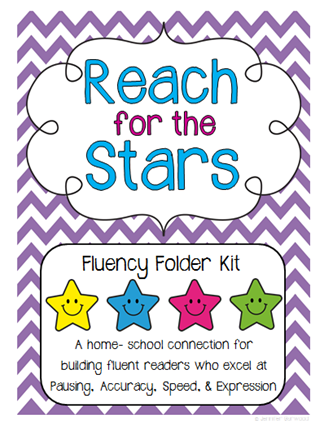
This year, I’m using my Reach for the Stars fluency folders with my second grade group, but honestly, I could see even my fifth graders benefitting from it if our time wasn’t already booked! The folders purposely don’t include passages, because I wanted teachers to be able to choose the passages that work for their students and differentiate as needed, and the rate graphs have five different options to work for any kids you teach!

IMG_1015

I know I am completely biased because I made these, but I love that these folders give students a focus on well-rounded fluency, while still only spending a few minutes daily on it.  The only thing that takes longer is the hot/cold reads on Monday and Friday, but in the past I’ve had parent volunteers help or had the students time each other in partners (so my pack includes clear directions for adults or kids!).

IMG_1029

These fluency folders are brand new to my store, but I’ve been using most of the elements for 5 or 6 weeks now, and they are such a great solution for fitting fluency instruction into my students’ day! They include everything you need for setting up homework folders (which could also be used in the classroom with partners), everything you need to record your students’ progress, and materials and lesson ideas for teaching what fluency is.

If you liked the Four Star Fluency bookmarks, you can grab them in black and white AND in color for FREE just by downloading the file preview here:
image

http://www.teacherspayteachers.com/Product/Reach-for-the-Stars-Fluency-Folder-928567

This product is on sale until tomorrow (Thursday, 10/17/13) at midnight—so I hope you’ll check it out if you think it might work for your kids! :)

Thursday, August 8, 2013

Tips for Meet the Teacher Night (and 5 FREEBIES!)

Hello friends- it's Throwback Thursday, to one of my most popular posts this week!


This open house/ meet the teacher night post was originally published August 25, 2012.

If you’re new here, you may not know that I’m running a series of new teacher tips called I Just Got a Teaching Job… Now What?!


I don’t know about you, but for me, meeting the kids is nowhere near as nerve-wracking as meeting the parents.

If your school has Open House, Back to School Night, Meet the Teacher Night, or anything of the sort, it’s probably one of your biggest worries as a new teacher.

For me, I student taught in Spring- so I hadn’t been part of any of this beginning of the year stuff, and I felt downright clueless. Since my parents didn’t officially come in before the first day, I made a brochure to leave on my door during registration with very basic information to know before school even started. Not every parent picked one up, but I had two or three parents mention it later, so I think it was a good move!

IMG_7927

Yes, the Scotch tape is not the best look, but it was falling apart without it! Let me know if you’re interested in the template and I can post that, too! Sorry- no idea where this has gotten to!

IMG_7928

This is one of those areas where talking to your fellow co-workers is so very important. You need to know:

  •  Is there an open house?
  •  Is open house before school starts, or after?
  •  Is there a set day/ time for the whole school or grade level, or do I choose when to have it for my class?
  •  Are students invited? What about siblings?
  •  What things do you hand out and talk about? Can I have copies? (Remember- digital is best for easy tweaking and not having to reinvent the wheel!)
  •  What sort of things do you set out for parents? Do you have them fill anything out?

At my old school, it happened before school, for the whole school on the same night, with a specific schedule. At my new school, we have a “walkabout” on the first day where parents can visit their child’s classroom before leaving, and most teachers also have their own parent meeting or open house in the next couple of weeks.

The time of your open house makes a big difference on what to do. It’s also a good idea to find out or decide if there’s a specific time frame for all of the parents to listen to you present, or if families will trickle in and out over a longer time frame.
If your open house occurs before school starts, think about what parents need to know.

You need to tell them:
  • what their child needs for the first day
  • how to best prepare their child for a new school year
  • how to communicate with you, and how you will communicate with them
  • that you are competent and confident
And the kids want to know:
  • where your room is
  • where their desk is
  • something about their teacher
  • something that will get them excited about the year!
When parents arrived at open house (for me, it was the 2nd week of school), here’s what they saw.

IMG_7938

The Target pocket chart had directions, and then I put out a parent sheet and packet. The sheet I wanted them to return was BRIGHT pink, to hopefully make it stand out.

IMG_8071

Grab your freebie copies of the parent information sheet and generic parent packet here.
When parents are trickling in, you want them to have something to do. I like to have things the kids are excited about, because then the kids drag their parents straight to their desks.

I had my kids give their parents a “quiz.” That day at school, kids filled out their favorites, and a note to their parent.

IMG_8007

When parents got there, the right answers were hidden, and the kids got to give their parents a quiz and grade it. (The novelty of this is so amusing to 3rd graders.)

IMG_8008

I got the quiz from Rachel at Minds in Bloom. You can pick up her freebie here.

After a quick summary of the packet from me, I gave parents time to check out a couple of stations where things were set out for them. I like to use some kind of tripod sign to make it clear where things are, and don’t forget to leave out some pens and pencils. Flower pens are great for making sure they don’t disappear! (You can see how I made them here.)

IMG_8064IMG_8068

You can also get a copy of my parent volunteer form here (free).

The kids also got to share some of the work they’d done- a mini-book, Graphing Myself (grab as a freebie from The Tattooed Teacher!), and an All About Me writing project.

IMG_8012IMG_8049

This was our first writing project. I model brainstorming important things about myself, such as things I like, things I’m good at, things about my family, places I’ve been, what I look like, how old I am, and if I’m a boy or girl.

IMG_8063
IMG_8051

Kids can use more than one page if they need to, and I staple them together along the top.

IMG_8054

Then, we glue it onto a big piece of construction paper folded in half. When parents come, they read the All About Me’s and see if they can guess who the page belongs to. If they think they know, they lift up the flap, and…

IMG_8050

see if they are right! We discuss ahead of time that their head should almost fill the page, and that they don’t look like a smiley face. We have noses, eyebrows, and eyes that don’t look like just dots. Unless long hair is covering them we have ears, too! We really focus on filling the page and adding lots of detail, and they turn out great.

IMG_8057IMG_8056IMG_8062IMG_8060IMG_8059IMG_8058IMG_8061

The kids love seeing if they can stump their parents, and they make a really nice keepsake. I also hang onto them until the end of the year so kids can see the difference in their writing skills, their handwriting, and their drawing.

You can pick up a freebie copy of the All About Me writing sheet here.

A couple last tips:
- Make sure you have a parent conference sign-up sheet, so that parents with concerns can be pointed in the direction of a sign-up, and hopefully you won’t have to stay all night.
- Get yourself a new outfit for the night. You don’t want to do the whole try-on-10-outfits-until-you’re-satisfied thing and be late! Don’t forget a piece of jewelry or two- I’m no fashionista, but you want to look pulled together to both make a good impression and to feel confident.
- Consider making a quick slideshow of the basics you want to cover. It’ll help you focus on your presentation.
- Good luck! :)

To recap, here are your freebies:
Parent Information Sheet (updated year)
Parent Packet for Open House (editable .doc)
Parent Volunteer Form
All About Me writing page
Parent Conference Sign-Up

And links to 2 freebies from friends:
Graphing Myself from The Tattooed Teacher
Parent Night Quiz from Minds in Bloom

Whew. I had a little more to show you, but I’m going to save it for tomorrow. Please, please, please leave a comment and let me know if you downloaded anything!
(I’d be so happy if you’d consider following or pinning anything you love, too!) Have a GREAT weekend!

Now that it's a year later, I would also add that Open House/ Meet the Teacher night is a great time to introduce Remind 101 (have parents sign up RIGHT THEN) and to show them how the Scholastic Book Clubs site works to encourage ordering! Make sure to emphasize that their orders help you get more books for the classroom!

post signature

Sunday, November 11, 2012

Parent- Teacher Conference Survival Guide

Whew! I have *one* conference left. Most nights this week I had 3 conferences plus an hour of tutoring. It is nice to be DONE!

I used Sign Up Genius for the first time. Even though I had to have different schedules on different days, it was easy to set up and it sent reminders so I didn't have to! I can't wait to use this for the holiday party.


I did have two no-shows, and a few parents didn't sign up, but 15/ 20 is not bad.

Last year I'd already had one-on-one conferences with a couple of parents, and didn't feel like I needed them with everyone, so I did an open-house style Family Share Night.
For Family Share Night, families stopped in whenever they wanted during the time frame. My students got a checklist when they walked in that told them what they should show their parents. There were 5 or 6 things for the family to do, including saying hi to me. Almost all of the parents got to talk to me for about 5 minutes and ask me any questions they had about how their child was doing. There was a place to sign up for a conference if they wanted it, but not one family did. It was a nice way to get everything done in one night.

This year, I wanted more one-on-one conferences. This was the first time I was running conferences myself, so here's the system I came up with for simple, organized parent-teacher conferences.


Each student had a folder, labeled with name and number.

As I put each folder together, I wrote out some quick notes on an index card of what I wanted to talk about. I always start with something positive, and try to touch on each subject, reminding myself what I want to show the parent along the way.


On the back, I wrote a few quick notes after the conference about what the parents said or talked about. This really helps as they all start to blend together!


Inside, I started with the goal sheet freebie from 3rd Grade Thoughts. I found it was a great way to give students a voice at the conference and, really, my kids were mostly very thoughtful about their strengths and weaknesses. I also included a copy of the grade card, but for obvious reasons didn't show that here.


Next is my Progress Profile. It was inspired by one here. It's basically how I'm keeping track of all my data in one place (reading on one side, math on the other). Now that conferences are (almost) over, I'm going to stick them in my teacher binder.


Behind that, I make sure to have printouts from the Star tests. I also have our Theme tests so far from the reading series. (The Beginning of the Year one is great for showing growth!) These include writing samples, too.


 I try to include a couple of other writing samples, including one from the beginning of the year (About Me freebie here) and one from more recently.


Can't forget reading and math journals, either! I can show their reading logs, written reading responses, and also some of their math thinking and explanation.


For math, I included some tests (usually one low, one high) and a Math Magic sheet to show my 3rd graders' proficiency on a variety of 2nd grade math skills. (She has 1st and 2nd grade versions, and they are SO worth every penny.)


I also include any other representative samples of their work, especially anything that was low on the report card, and I end with one more positive, letting them ask any questions they have, and thanking them for taking the time to come in.

It takes some time to pull all the data together, but I really liked how organized I felt at the conferences. I really try to focus on the growth angle, especially with my lower achieving students. And if we're not seeing growth, I really try to pull the parent into the equation by asking what they are seeing at home and if they have any ideas.

Whew! It's a lot of work, but I love getting to sit down with parents and brag on their kids. They are so supportive of their kids, and mostly, of me- and it makes it so worth it to spend my own time doing conferences.

Okay, bribing myself with these also helped.


Mint candy with bits of candy cane inside. I was SO excited to see they're back in season already!

Adding this to my summer series for any new teachers out there :)

How do you keep parent-teacher conferences and data organized?

Saturday, August 25, 2012

Open House or Meet the Teacher Night for New Teachers- FIVE freebies!

I've been running a series of new teacher tips called I Just Got a Teaching Job… Now What?!


I don’t know about you, but for me, meeting the kids is nowhere near as nerve-wracking as meeting the parents.

If your school has Open House, Back to School Night, Meet the Teacher Night, or anything of the sort, it’s probably one of your biggest worries as a new teacher. For me, I student taught in Spring- so I hadn’t been part of any of this beginning of the year stuff, and I felt downright clueless.

Since my parents didn’t officially come in before the first day, I made a brochure to leave on my door during registration with very basic information to know before school even started. Not every parent picked one up, but I had two or three parents mention it later, so I think it was a good move!

IMG_7927

Yes, the Scotch tape is not the best look, but it was falling apart without it!

IMG_7928

This is one of those areas where talking to your fellow co-workers is so very important. You need to know:

- Is there an open house?
- Is open house before school starts, or after?
- Is there a set day/ time for the whole school or grade level, or do I choose when to have it for my class?
- Are students invited? What about siblings?
- What things do you hand out and talk about? Can I have copies? (Remember- digital is best for easy tweaking and not having to reinvent the wheel!)
- What sort of things do you set out for parents? Do you have them fill anything out?

At my old school, it happened before school, for the whole school on the same night, with a specific schedule. At my new school, we have a “walkabout” on the first day where parents can visit their child’s classroom before leaving, and most teachers also have their own parent meeting or open house in the next couple of weeks.

The time of your open house makes a big difference on what to do. It’s also a good idea to find out or decide if there’s a specific time frame for all of the parents to listen to you present, or if families will trickle in and out over a longer time frame.

If your open house occurs before school starts, think about what parents need to know. You need to tell them:
  • what their child needs for the first day
  • how to best prepare their child for a new school year
  • how to communicate with you, and how you will communicate with them
  • that you are competent and confident
And the kids want to know:
  • where your room is
  • where their desk is
  • something about their teacher
  • something that will get them excited about the year!
When parents arrived at open house (for me, it was the 2nd week of school), here’s what they saw.

IMG_7938

The Target pocket chart had directions, and then I put out a parent sheet and packet. The sheet I wanted them to return was BRIGHT pink, to hopefully make it stand out.

IMG_8071

Grab your freebie copies of the parent information sheet and generic parent packet here.

When parents are trickling in, you want them to have something to do. I like to have things the kids are excited about, because then the kids drag their parents straight to their desks.

I had my kids give their parents a “quiz.” That day at school, kids filled out their favorites, and a note to their parent.

IMG_8007

When parents got there, the right answers were hidden, and the kids got to give their parents a quiz and grade it. (The novelty of this is so amusing to 3rd graders.)

IMG_8008

I got the quiz from Rachel at Minds in Bloom. You can pick up her freebie here.

After a quick summary of the packet from me, I gave parents time to check out a couple of stations where things were set out for them. I like to use some kind of tripod sign to make it clear where things are, and don’t forget to leave out some pens and pencils. Flower pens are great for making sure they don’t disappear! (You can see how to make flower pens here.)

IMG_8064IMG_8068

You can also get a copy of my parent volunteer form here (free).

The kids also got to share some of the work they’d done- a mini-book, Graphing Myself (grab as a freebie from The Tattooed Teacher!), and an All About Me writing project.

IMG_8012IMG_8049

This was our first writing project. I model brainstorming important things about myself, such as things I like, things I’m good at, things about my family, places I’ve been, what I look like, how old I am, and if I’m a boy or girl.

IMG_8063
IMG_8051

Kids can use more than one page if they need to, and I staple them together along the top.

IMG_8054
Then, we glue it onto a big piece of construction paper folded in half. When parents come, they read the All About Me’s and see if they can guess who the page belongs to. If they think they know, they lift up the flap, and…

IMG_8050

see if they are right! We discuss ahead of time that their head should almost fill the page, and that they don’t look like a smiley face. We have noses, eyebrows, and eyes that don’t look like just dots. Unless long hair is covering them we have ears, too! We really focus on filling the page and adding lots of detail, and they turn out great.

IMG_8057IMG_8056IMG_8062IMG_8060IMG_8059IMG_8058IMG_8061
The kids love seeing if they can stump their parents, and they make a really nice keepsake. I also hang onto them until the end of the year so kids can see the difference in their writing skills, their handwriting, and their drawing.

You can pick up a freebie copy of the All About Me writing sheet here.

A couple last tips:
- Make sure you have a parent conference sign-up sheet, so that parents with concerns can be pointed in the direction of a sign-up, and hopefully you won’t have to stay all night.
- Get yourself a new outfit for the night. You don’t want to do the whole try-on-10-outfits-until-you’re-satisfied thing and be late! Don’t forget a piece of jewelry or two- I’m no fashionista, but you want to look pulled together to both make a good impression and to feel confident.
- Consider making a quick slideshow of the basics you want to cover. It’ll help you focus on your presentation.
- Good luck! :)

To recap, here are your freebies:
Parent Information Sheet (updated for 2013-2014)
Parent Packet for Open House (editable .doc)
Parent Volunteer Form
All About Me writing page
Parent Conference Sign-Up

And links to 2 freebies from friends:
Graphing Myself from The Tattooed Teacher
Parent Night Quiz from Minds in Bloom

Whew. I hope this helps! I’d be so happy if you’d consider following or pinning anything you love, too! Happy back-to-school time!