photo Image277_1x1_zps92a4c832.gif photo Image277_1x2_zps82501ae2.gif photo Image277_1x3_zpse2f7619b.gif photo Image277_1x4_zpsbfd3d820.gif photo Image277_1x5_zps55244bd5.gif photo Image277_1x6_zpsa94012cf.gif
Showing posts with label freebie. Show all posts

Sunday, June 26, 2016

Shark Week: Take a Bite Out of Learning

It's that time again! I am so excited to be hosting this year's Shark Week link-up with Matt from Digital: Divide and Conquer.

I'm a fourth grade science teacher who used to work as a reading specialist, so I am always looking for ways to incorporate a little reading into my science lessons. One of our standards asks kids to look at how fossils are used to tell us about the past, and I love to get kids comparing prehistoric creatures with similar ones alive today.

Of course, kids LOVE to read about a giant shark called the megalodons- so for Shark Week, I'm sharing this quick freebie with you! On this "Then vs. Now" passage, your kids will have a chance to compare and contrast great white sharks and megalodons using the color-coding strategy that's been so popular in my Text Detectives- Find the Text Evidence resources.


Better yet, this asks them to go beyond just color-coding and use text evidence to write an essay that compares and contrasts these two sharks. I hope your kids really enjoy learning about these amazing animals! Click on the photo above or click HERE to download.

Be sure to go on to Heather's blog at Learning with Mrs. Langley and check out her freebie. You can follow the hop around or look at the Inlinkz below to find some great resources for your classroom- but hurry! These JAWSOME freebies may only be free during Shark Week!


post signature

Sunday, February 22, 2015

A Spark of Inspiration Blog Hop

Happy weekend, teacher friends! If you’re new here, I’m Jenny, a 4th grade science and social studies teacher who loves integrating language arts across the curriculum. Thanks to Sarah from Sarah’s First Grade Snippets for sending you here!

Sarah's First Grade Snippets!

While I was in college, I started reading teacher blogs. I discovered a new world of learning and inspiration- and I quickly realized I wanted to be a part of this world.

Now that I’ve been blogging for a few years, I feel so fortunate to also collaborate with some of those amazing teachers from around the country.

If you’ve been a reader of our blog A Class*y Collaboration, we’ve updated the look and name to match exactly what we want to give you- A Spark of Inspiration!

A Spark of Inspriation

I know you may be thinking that reading another blog takes time- but this is a good one! To give you a taste of what you’ll find over there, here are photos from just a few recent posts:


Plus, if you live anywhere near me in Ohio, the weather is cold and snowy enough that staying in to read teaching ideas is pretty ideal! (Can you say wind chill of –20? Brr!)

2015-02-18 10.33.20

To thank you for checking out the new blog and to help ring in spring weather, each one of our authors is offering a quick freebie- and the chance to win some serious gift cards!


I’m sharing a sample of my newest resource that’s juuuust about ready for TpT- Text Detectives Jr.! Like my original Super Text Detectives series, your students color-code text evidence to answer comprehension questions… but the original set is written at about 3rd grade level (independent) , and the new Text Detectives Jr. sets are about a 2nd grade level! March’s full Super Text Detectives Jr. pack should be posted in my store by early next week- but you get a sneak preview!

Luckeyfrog's Lilypad- Text Detectives JR- March Sampler

The passages in TD and TD Jr. have similar content and similar questions so that you can use the two packs together for differentiation in your 2nd or 3rd grade class, too! Click on the picture to download your free sample passages!

You can read more about how I use them to teach my kids how to find text evidence here. When I was a reading specialist last year, my students LOVED these- and they really helped them learn, too!

2014-03-26 22.44.43

Thanks for stopping by my little corner of the Internet  : ) Be sure to check out each blog to grab some freebies and enter our giveaway… starting with Megan from Mrs. Wheeler’s First Grade!


a Rafflecopter giveaway

Tuesday, January 6, 2015

Winter Wonders Freebie Blog Hop

Whew! Today was my first day back, and I have to say that I was not ready for an alarm before 7:00… but I got up, got ready, and after enduring some sad faces from my dog and a frozen-shut car door, I got to school.

I was having a hard time getting in the groove, and then the kids came in… and I remembered why I do this!

The winter blahs are tough sometimes, but my friends from the Adventures in Literacy Land blog are here to cheer you up with some Winter Wonders freebies to celebrate our one year blogiversary together!


Today our group of reading specialists, literacy coaches, and Title I teachers are sharing some short posts and free literacy resources for you- so be sure to follow the link at the end of my post to the next one! At the end of our “hop,” you can enter to win a Barnes and Noble gift card!

When a struggling reader is told to go back in the text, you can see their face fall. They JUST pushed themselves, and maybe embarrassed themselves, to make it through the text- and you are asking them to go BACK? Are you kidding?

Slide3

Telling kids to go back in the text with no extra guidance is a surefire way to make sure that they ONLY do it when you’re watching. Struggling readers need a method to the madness!

Last year as a reading specialist, I worked with so many kids who didn’t want to stop in the middle of the reading, because it slowed them down even more- but without me slowing them down, they were thinking about the next word, and not about how that word fit into a sentence, how that sentence fit into a paragraph, and so on. They couldn’t build meaning as they read.

We practiced stopping after each paragraph to write the topic off to the side. It wasn’t even a summary, really- just a few words to answer, “What was this paragraph about?” By jotting it down, my students had an easy reference- almost like a table of contents for their passage.

Slide4

Then, when we finished it, we glanced back at the topics. It’s a quick way to recap the text’s main ideas.

By the time we get to the questions, we know what each PART of the text is about- which makes it so much easier for kids to predict where to look for the answers to the questions. Oh, it's talking about where George Washington was born? That's probably in the paragraph about his childhood- and now I know where to look first.

Of course, our predictions aren’t always right- and it’s important to model that for kids- but stopping as students read to really get them thinking about the big ideas of the text helps give them somewhere to start.

When you’re not a strong enough reader to scan and quickly find the answer in a large piece of text, a strategy that gives you somewhere to start drastically increases the likelihood that you’ll even try looking back in the text.

And while this is a great test prep strategy, it’s also fantastic for real-life applications like research that require looking up specific pieces of information and even deciding which Google result to click on in a search.

Want to try it out? I’m sharing a free snow-themed sampler of my Text Detectives series for finding text evidence!

snowsampler

download here }

IMG_7530

It’s my students’ favorite way to practice finding answers for “right there” questions in text, because they get to color! I aim for about 3rd grade reading level, although it works well in 2nd –4th. You can read more about how I use them in my classroom here.

Next, hop over to Deniece at This Little Piggy Reads for the next Winter Wonder!


Thanks for stopping by!  Don't forget to hop all the way to Adventures in Literacy Land to enter our giveaway and welcome our new members! Happy Winter!

post signature

Tuesday, March 4, 2014

Teaching Kids to Go Back In the Text When Answering Comprehension Questions

Since I’m a reading specialist, I see even MORE kids than usual who are lazy in reading. When I give them a reading passage, they try to skip reading it and then they randomly search for the answers. When they can’t find them instantly, they get frustrated and guess.

Reading is hard, so they want to get it over with- and going BACK to the text, after I already read it? No way is THAT gonna happen!

refer to text graphic

My students are finally going back to the text- but it’s in large part because we’ve learned how to make it easier. (Okay, and when I use Text Detectives, they’re kind of forced to.) Here are our steps:

Slide3

Depending on how independently your readers can access the text, I vary between reading it as a group, with partners, or individually.

Slide4

On one side, we label each paragraph by number. (We use arrows to find the indents, which helps.) We put little brackets off to the side of each paragraph and they use 1-3 words to tell the topic of that paragraph. You can see here that the first paragraph is the intro, the second paragraph is about when he was a kid, etc.


Slide5

Then, we read the first question and circle the question word. We’ve learned about each question word, so we know that when it says “where” we’re looking for a place and we need to keep an eye out for place words, including proper nouns with capital letters.

Slide6

After that, we underline any key words. These are words that we think might be found near the answer. They’re going to help us narrow down where the answer might be. Of course, these words aren’t always near the answer- but it gives us something to look for.

Slide7

Next, we predict where this answer might be found using our summary words from earlier. It’s not always clear, but sometimes we can clearly decide, “Oh, this is about when George Washington was born. It’s not going to be in the part where he was in war, or the part where he was President… it’s probably going to be in the part that talks about his childhood.” I have my students put a little number next to the question that shows which paragraph they’ll look in first.

While we’re learning about this, I do a lot of thinking aloud to model what my students should have going through their heads. Then, as we do it together, I say, “Where do you think we should look first? Why?”

Slide8

Finally, we go to that paragraph of the passage and skim for the key words. When/ if they find one, they go back to the beginning of the sentence and see if it answers the question. If they can’t find key words, they read that whole paragraph to see if they can find the answer.

With these Text Detectives sheets, I have my kids underline JUST the answer- not the surrounding sentence- so I know they can pinpoint the exact answer. Of course, we also work on writing our answers in complete sentences… but first, they have to know exactly what the answer is.

And when they find it, they’re allowed to color the crayons (because, for some reason, they can’t stand to leave them white!)

Once we’ve practiced this a few times, my kids feel a lot more comfortable trying it themselves! Of course, our kids can’t always use these exact strategies on a test- but for those struggling kiddos especially, this gives them a process to try and a place to start. And I love that it's not just "test prep," but valuable skills for real reading and research too!

One last thing: I love to use my Text Detectives packs to teach finding text evidence, but hopefully these are strategies you can use or adapt with ANY text. On the off chance that you want these, though…

seuss preview

I've written Text Detectives passages for every month of the year, and you can choose the 2nd grade or 3rd grade reading level. The passages are similar so they can even be used together in the same classroom for differentiating! If you’re interested, you can find Text Detectives here and try out a Dr. Seuss reading passage for free by downloading the Preview file.

Another really helpful strategy for my kids in the next step of this process (looking back in the text both when the answer is explicitly stated, and when it’s not) is a version of QAR called the 4-H strategy.


You can read more about it here from my friend Kylie at Ripper Reading Resources.

*How do you work with your students on answering questions in the text?*

Edited to add: This post originally contained a giveaway which has now ended. Please be sure to follow my blog for future giveaway opportunities!

Friday, November 22, 2013

The Gift of Reading Blog Hop-- Stop #8


Welcome to Luckeyfrog's Lilypad. You have arrived at  


At each blog stop, you will be gathering Reading gifts and freebies.  In each post you will find a picture of a snowman with a letter on it. Collect all of the letter to solve the mystery quote to enter the giveaway. Record all of the letters on your recording sheet and follow each blog along the way so that you can enter the amazing giveaway at the end!

The hop is set up as a loop, so you may start anywhere along the hop, but if you would like to start at the beginning you may go to A Day In The Life of A Title I Teacher's blog.  This is also where you will go after you finish the hop to enter the giveaway!!

I'm so glad you're here! I'm a reading specialist in Ohio and I have always loved reading. I've even gotten a chance to work with Scholastic Reading Club this year!


The last two years, I taught 2nd and 3rd grade. These students are just starting to venture past decoding and into deeper books with more emotion and more complicated, interesting stories- which I LOVE!

The tricky part, though, is that while many of them can do basic word decoding, they struggle with the bigger words that come with these new books (especially chapter books!). I work with my students a lot on "chunking," or breaking a big word apart into smaller parts that they know or can decode. 

I developed a few games for my class that specifically help my students build confidence at breaking apart these smaller words and get better at recognizing phonics patterns within multisyllabic words. 


The words are slightly split apart to help students develop this skill, and use common suffixes.


To make it more fun, I turned this into a card game with "Naughty" or "Nice" cards that will randomly turn up in the game and cause them to give back cards or get extra cards! The kids in my class have really loved this type of game and I see a huge difference in their willingness to dive in and apply their phonics skills to even those "big" words!


You can pick up Naughty or Nice: A Multisyllabic Word Decoding/ Fluency Game here at my TpT store. (Be sure to check out some of my other freebies while you're there!)

My secret letter is...


Thank you for stopping by my blog today! I hope that you enjoyed your gift and learned something new. If you would like to be the first to know about new post, giveaways, and blog hops follow me on Bloglovin' by clicking the image below. You can find my other social media on the top right of the page!


Don't stop now! Hop on over to Mrs. D's Literacy Lab to pick up another amazing reading gift! Happy Holidays! 


If you get lost along the way download the Hop Map here to easily pick back up where you left off! 

Thank you so much for visiting! Enjoy the hop!

post signature

Monday, October 21, 2013

My Truth Monday- and a Motivation Freebie!

Today I want to get a little more personal. A few months ago, I tried MyFitnessPal for tracking my food and it really helped motivate me to eat better and get more active. I wanted to do it right-- gradual, and still enjoying my favorite foods but in moderation, so that I'd stick with it!

When I moved and gave back the school's iPad, I lost momentum and since the end of June, I've gained back the 15 pounds I lost- plus added another 5 for good measure. (The stress of job searching combined with using MFP's website instead of the app didn't help my willpower, for sure.) 

The last few weeks, I've been trying to get back on track with some other teacher friends.So when Denise started a new Monday blog post party, I had to join!

I'm tracking my food again, I'm trying to get a little more exercise, and I'm headed back in the right direction! It's been tough, though, to get my body back to where I know it really should be to be healthy. I've always had curves, so I'm not trying to lose those- but I want to feel good in my body again, you know?

I have been really working at working out more, drinking more water, and tracking my meals- but I need to start using what I know about myself and join something that I will really enjoy!

I also needed a little motivation, so I worked on making this that I can print out. It will work for your personal goals OR for in your classroom. 

Do Your Best Subway Art- Free from Luckeyfrog's Lilypad (b&w).PNG       Do Your Best Subway Art- Free from Luckeyfrog's Lilypad (color)-001.PNG

You can pick up a free copy of the black and white or color version by visiting my Facebook page.  (Of course, it won’t have the watermark going across the middle.) Thank you so much for following my blog!

Want to share your truth? You can link up with Denise at Sunny Days in Second Grade or share in the comments. Hope you have a GREAT week!


post signature

Thursday, October 17, 2013

Teaching Fluency with Fluency Folders

Teaching fluency is so important for reading teachers, but in recent years, DIBELS and AIMSweb have put such a heavy focus that it sometimes confuses students.

We’ve all seen that kid who sits down to a fluency diagnostic and speeds through way too fast, getting a high score on the assessment but not showing good reading skills in the slightest! I’m sure we can all agree…

IMG_1009-001

I think all these assessments are giving fluency a bad rap. It really IS important for our kids to be able to read fluently, and fluency diagnostics are used so often because, honestly, most kids who can read fluently (truly fluently, not just fast) really are better readers.

We just have to make sure that fluency in our classrooms means more than JUST a fast pace! I like to teach it as the right “PASE” instead. I like to break fluency into four parts: Pausing, Accuracy, Speed, and Expression! YES, speed is part of it- but no, it’s not everything!

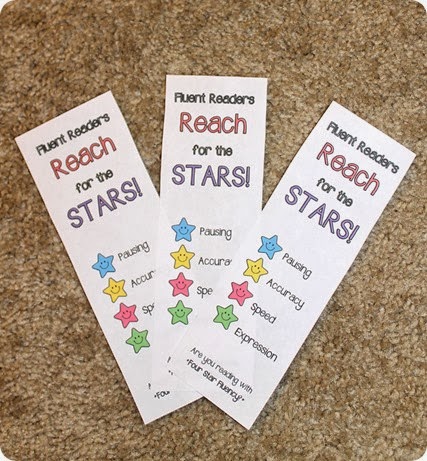
The description of fluent reading that resonates the most with my students is “not reading like a robot,” but reading the same way we talk. I think modeling great fluency is the best thing we can do to teach it, but I also think we need to point out to our students what we are modeling. I teach each element of fluency as one “star” and teach it individually, using an anchor chart and giving the students their own bookmark. (Interested in a free copy of these? Read on!)
IMG_1024

One of my favorite things about teaching fluency, though, is doing Cold/ Hot reads. You’re probably thinking that I’m crazy—after all, hot and cold reads emphasize speed. But hot and cold reads also emphasize how practicing reading helps you improve at reading, and when students see themselves improving (especially the struggling readers I teach as a reading specialist), it builds confidence in such a vital way and encourages them to read more outside of school.

With struggling kids, as long as their data is showing growth, I think it’s so important to show them the data! I am constantly looking for ways to show my students their growth (through data, recording their reading to let them listen, encouraging parents to share what they notice, etc.) because it shows them that they are making progress. I’m seeing some kids who have been coming for extra help in reading for 2, 3, or 4 years. They see themselves as bad readers and hate reading, but when they see that they are growing… well, it means reading isn’t just something to give up on anymore.

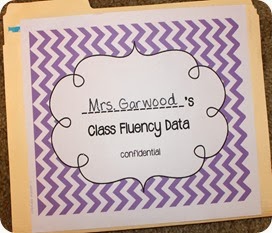
Plus, I can make sure that the instruction I’m doing for these kids is actually working! I like to track my student data in this folder. (LOVING Washi tape!)
IMG_0968       IMG_0988

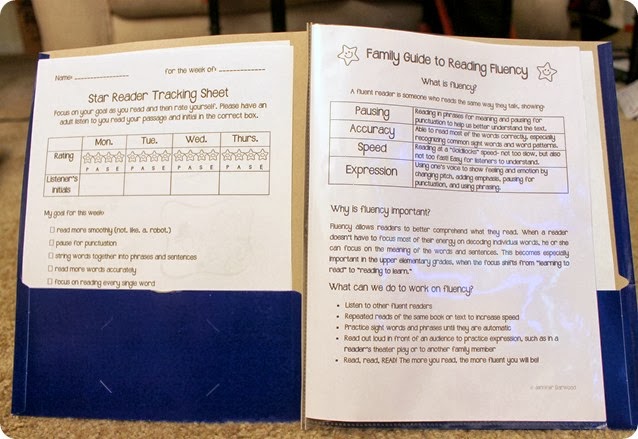
So—hot and cold reads are great for showing improvement, but I feel the trick is to make them about more than just speed. My students set a weekly goal for their fluency in one of the four “stars” of fluency and focus on improving towards their goal- whether it’s speed, or something else! (You can see the top of the weekly Tracking Sheet with goals below!)

Then, after some reading time (free reading or a book sent home by me- because authentic reading is the most important thing!), they practice their passage once each night at home and, with the help of a parent, rate their reading fluency.  It’s quick—5 minutes at most!
IMG_1013

I’ve also gotten great feedback from the parents on the materials that explain to them what fluency is and what activities they can do to work on it.

By Friday, the students get to be involved in tracking their own progress. (What kid doesn’t love coloring in a graph?)

IMG_1009

This year, I’m using my Reach for the Stars fluency folders with my second grade group, but honestly, I could see even my fifth graders benefitting from it if our time wasn’t already booked! The folders purposely don’t include passages, because I wanted teachers to be able to choose the passages that work for their students and differentiate as needed, and the rate graphs have five different options to work for any kids you teach!

IMG_1015

I know I am completely biased because I made these, but I love that these folders give students a focus on well-rounded fluency, while still only spending a few minutes daily on it.  The only thing that takes longer is the hot/cold reads on Monday and Friday, but in the past I’ve had parent volunteers help or had the students time each other in partners (so my pack includes clear directions for adults or kids!).

IMG_1029

These fluency folders are brand new to my store, but I’ve been using most of the elements for 5 or 6 weeks now, and they are such a great solution for fitting fluency instruction into my students’ day! They include everything you need for setting up homework folders (which could also be used in the classroom with partners), everything you need to record your students’ progress, and materials and lesson ideas for teaching what fluency is.

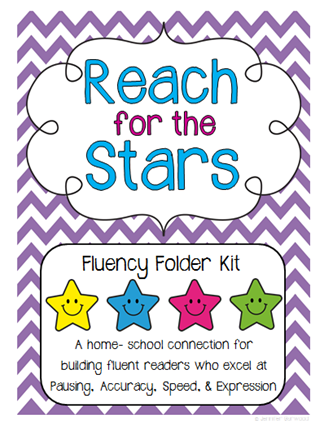
If you liked the Four Star Fluency bookmarks, you can grab them in black and white AND in color for FREE just by downloading the file preview here:
image

http://www.teacherspayteachers.com/Product/Reach-for-the-Stars-Fluency-Folder-928567

This product is on sale until tomorrow (Thursday, 10/17/13) at midnight—so I hope you’ll check it out if you think it might work for your kids! :)