photo Image277_1x1_zps92a4c832.gif photo Image277_1x2_zps82501ae2.gif photo Image277_1x3_zpse2f7619b.gif photo Image277_1x4_zpsbfd3d820.gif photo Image277_1x5_zps55244bd5.gif photo Image277_1x6_zpsa94012cf.gif
Showing posts with label I Just Got a Teaching Job... Now What?. Show all posts

Sunday, June 9, 2013

Get Organized for Next Year NOW! {plus a free 2013-2014 calendar!}

I’m so excited to link up for my first-ever Monday Made It with a free printable 2013-2014 calendar for the school year! Read on to find out how you can get your copy of the July 2013-July 2014 calendar.

calendar pinterest preview

Today’s tips are about getting organized during the summer.
The first few weeks will be crazy- so what can you do before they start? Here are the most important things:

- Make a file folder for each child in your class.

IMG_9140

I number these instead of putting names- a little more anonymity if someone sees my file cabinet my mistake, and I don't have to re-label them every year. I keep any parent notes, tardy slips, nurse notes, example work I want to show parents, etc. and I always pull this out for parent conferences.

- Make generic class checklists.

[not shown- all my photos have student names! Sorry!]

A generic checklist will be used about a bazillion times. Field trip forms? Check. Money sent in for something? Check. Homework turned in? Check. I also keep one in the cover of my binder at all times, and one in my emergency bag that I grab for drills. Alphabetical order with class numbers works best for me! Don’t make a lot of copies yet (because class lists ALWAYS change in the first week or two) but tweaking a name or two on the form is much easier than typing it all up once school has started and you have a million other things to do!

 - Design your daily schedule. (Here's how I use Google Calendar.)
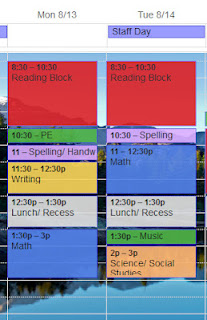


As soon as you have a specials schedule, this is so important! Put in the required things first, and don't forget about logistical things- bathroom break after lunch, for instance. I use Google Calendar to quickly move things around where I want them before I stick it in a Word document.


- Use this schedule to set up your planbook.

IMG_0083

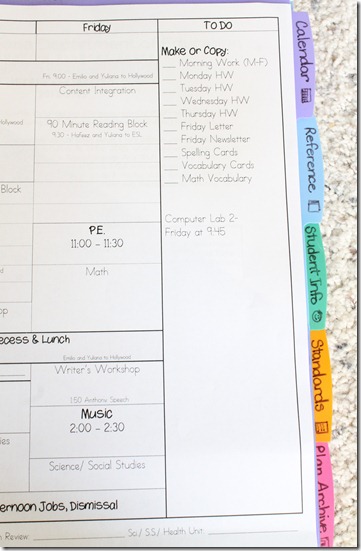
Of course, I love my lesson planning pages in Word. Hopefully, you read about my lesson plans, picked up a free starter plan template to customize, and then read my tips for personalizing your lesson plans. Print out a few for the first few weeks- you'll change and update them after that.

- Set up your grade book. (I use Engrade.)


Look at your report cards and ask other teachers what sorts of data you are required to keep, if you’re a new teacher. Is spelling part of "Language Arts," or is it a separate subject? I like to use a digital gradebook because it makes calculations easy and I can access from home or school. Engrade is super easy for inputting grades on the iPad, which I love. I can also weight categories without doing the math by hand.

- Make yourself a teacher binder.

IMG_0055

If you don't know my love for my organized teacher binder, welcome. You must be a new reader. I promise you- this thing is my number one, top, favorite item for keeping myself organized. Make sure it includes all of the things you will need with you around the school (staff meetings, computer lab, copy room) and at home (calendar of school events, planning pages, standards/ planning documents).

- Set up a calendar. I really like to put mine in my teacher binder!

IMG_0100

Unless you DON'T tend to pile things on your desk, don't try a desk calendar. Believe me when I say that it will end up under a stack when you need it, and then you won't write something down, and then later you'll forget about it because you didn't write it down... basically, if it's covered up very often at all, it's already not doing its job as a calendar. I do like Google Calendar a lot, but I don't have a smartphone and therefore Google Calendar is not always with me.

If you are looking for a printable calendar, like I was, there are a few beeeautiful freebie options on the internet. The tricky thing about that is that most of them are only released by calendar year. Not only does it not match, but I also don’t usually have the January- May calendar to use yet early in the fall and it makes it harder to plan ahead.

Problem solved- a school year calendar that’s colorful, but not too much color ink to print. For a limited time (until next Monday, June 17), I’m going to offer this FREE to Facebook fans. You can ‘like’ my page here, or by clicking on one of the photos below.

Calendar Cover
Calendar Preview 3Calendar Preview 1

Now that the freebie is done, you can purchase this calendar for $2 here!

Make sure you go through the school calendar and add the big dates- school breaks, meetings, etc. I also like to number the weeks of the school year for my planning!
I’m adding this to my new teacher tips…



Monday Made It at 4th Grade Frolics


and linking up with two of my favorite blogs, Ladybug’s Teacher Files and Fun in Room 4B for their Optimum Organization linky party this week!


A little organization before the school year can go a long way toward keeping you organized during the school year! What sorts of things do YOU do to pre-organize for your new class each fall?

Tuesday, March 19, 2013

Teacher Binder Remix!

I’ve posted before about my teacher binder. As an organizationally-challenged person, I had to find that one thing that would hold me together as a teacher… and my binder is it.

I love this thing. It’s within an arm’s reach at any given moment (home or school) and keeps me sane. And honestly? Creating it was simple.

how to create a teacher binder ~ luckeyfrog's lilypad

Unfortunately, my teacher binder had seen better days, so it was time to perform a little overhaul.

IMG_0034

While I’m working on my own, I thought I’d share 5 steps to creating your own teaching binder!

1. Plan first.

For me, the easiest way to do this was to gather all the papers I thought I wanted in my binder, and split them into piles. This will help you know how many dividers and what size of binder to buy. Don’t forget that you can use the space in front of and behind the dividers!

2. Get the supplies.

Pick a binder you LOVE (for me, color is huge) and splurge for the heavy duty one. Believe me- you’ll be using this thing a lot.

I also picked dividers that had pockets and were easy to write on (and erase, if I change my mind later).

how to create a teacher binder ~ luckeyfrog's lilypad

A friend gave me Vera Bradley binder clips, and I use this one to pin my lesson plans to the cover so that the 2-page spread opens instantly when I open the binder.

how to create a teacher binder ~ luckeyfrog's lilypad

This binder clip also adds just enough “cute” to make me smile whenever I look at my binder! It sounds silly (seriously who has designer binder clips) but I probably see it 20 times each day. Worth it.

how to create a teacher binder ~ luckeyfrog's lilypad

3. Think about the covers.

What are the things you constantly need to reference? For me, a cute cover with my name on it would be okay- but really, I need my class list, my current Post-It list, and the weekly newsletter (with spelling & vocab. words, academic focuses, etc.).

how to create a teacher binder ~ luckeyfrog's lilypad

Normally, this would have a class list, which I didn’t show for obvious reasons, and there’s usually a Post-It list or two. Still… I like how clean and neat my binder looks on my desk! (Plus, the color stands out if it does find its way into a pile.)

4. Think about order.

What papers do you need access to the most often? My lesson plan pages go in the front because I reference them throughout every day, and my calendar goes next.

how to create a teacher binder ~ luckeyfrog's lilypad

(I love Google Calendar, but a written one works best for me. I printed this one for free from The Twinery Blog.)

how to create a teacher binder ~ luckeyfrog's lilypad

I put any lists for quick reference (computer logins, school schedules, curriculum maps, policies, etc.) in the reference tab.

My Student Info tab holds my data (so useful when I plan my small groups at home!), but also copies of anything like IEP’s, ILP’s, RTI plans, and documentation.

how to create a teacher binder ~ luckeyfrog's lilypad

The back includes things I might need to look up once a week while planning, but not daily, like my standards lists and my archive of planning pages/ meeting notes.

Once you’ve decided, write on the dividers. (I used a skinny Sharpie- on most surfaces, nail polish remover will take it right off if I ever change my mind!)

how to create a teacher binder ~ luckeyfrog's lilypad

4. Hole punch everything and try it out!

This is the perfect time of year to give this baby a trial run and give you plenty of time to tweak it for next year!

I found out that having a “meeting notes” section was just not enough for me, so I added some extra subsections. You’ll find what works for you!

I plan my teacher binder as something that I will take to every meeting, take home every night, and use constantly throughout my day. It means that whether I’m at home, in my classroom, or somewhere in the school, I have everything I need to stay organized and up-to-date!

There are plenty of other guides out there to making a teacher binder, but it’s my hope that this can help you make the one that’s right for you. Yes, it takes a bit of time… but I put mine together in about an hour (minus shopping) and it has saved me so much more than that!

Thursday, March 14, 2013

Teacher Emergency Kit

One of the things I always recommend to new teachers is to have that special drawer for “just in case.”

Because you’re going to have those days.

I have a desk drawer that, covered, looks like this.

IMG_9458

The black part comes off, though, and here’s what’s hiding underneath. I know- not the cutest thing, but I like to be a bit discreet.

IMG_8047

Medical

IMG_8040
  • Extra glasses. My eyes are pretty bad, so if I had contact trouble or break my glasses, I would be completely incapacitated without backups.
  • Tylenol and Advil (including some extra-strength)- for those days when your headache just will not quit.
  • Extra tissues. Since this photo, I’ve found a pack of the lotion ones and I’ve stashed those instead for when I’m really sick.
  • *ahem* Feminine needs. Don’t forget this one.
Makeup

IMG_8039
  • Last time I needed new foundation, I put the almost-gone bottle in here for when I forget staff picture day or have a breakout out of nowhere. This is pretty necessary for a girl like me who goes sans makeup most days.
  • A basic eyeshadow. It’s not my favorite, but it’ll do in a pinch to make me look a bit more pulled together (or awake).
  • Face moisturizer and body lotion. (I usually go for a scented lotion so that if I feel a little gross I can smell a bit better. Nothing too overpowering, though.)
  • Chapstick.
Hair (plus a few other things)

IMG_8043
  • Spare hairbrush.
  • Bed Head “Control Freak”- so great for controlling frizz.
  • Extra hair ties. Usually for me, but occasionally I’ll give one to a kid if they really need it (either for hair, or for something like a makeshift belt).
Others to Consider
  • Shout Wipe (or Tide pen)- you’re gonna need this at some point… probably on a day when you have a meeting/ conference/ observation.
  • Lock De-Icer. Or maybe it’s only my old car that doesn’t love Indiana winters. After one time of having to crawl in from a back door and climb over the seat, I decided to leave one of these bad boys at school juuust in case I can’t tug even the back door open next time.
  • Emergency chocolate. I, however, have zero willpower, so you’ll notice it’s not here.
  • Vitamin C drops. I love the ones that taste like candy for when I feel a cold coming on. I know a lot of other teachers who depend on Airborne or Emergen-C.
  • Cough drops or sore throat drops.
  • Some kind of granola bar or meal bar, and maybe a bag or two of microwave popcorn- something that will tide me over when I forget my lunch!
  • A sweater for when your room is cold. (A simple black or white cardigan will go with almost anything!)
  • Comfy flats (if you wear heels often).
  • Spare cell phone charger.
This stuff has come in handy over and over. Definitely something new teachers should put together! (And so I’ve linked up to my new teacher series :)

new teacher guide logo

So, tell me, teachers… what are YOUR must-haves for a teacher emergency?

Wednesday, November 21, 2012

Cuckoo for Cotton Balls!

This is so simple that I can't believe I haven't posted about this, but I also think it's hugely worthwhile.

I have a cotton ball jar in my classroom. I started with cotton balls and meant to upgrade to those craft puffball things, but never did, and I have to say- dollar store cup and cotton balls have worked just fine.

Photo Source: http://write-to-learn.tumblr.com/post/22330500361/miraculous-marble-jar


It's not a new idea, at all. Many people use a marble jar or something similar, and kids get to add a marble whenever they get a compliment or do something exceptionally well as a class.

1 Compliment = 1 Cotton Ball

But I don't stop there. There are certain things that I think are worth more. For instance, a compliment from a lunch or recess supervisor? In my last job, that was ME- so it's definitely worth extra.

1 Compliment at Lunch/ Recess = 2 Cotton Balls

Another time that behavior is hugely important is a safety drill. For me, there's no talking, no excuses- and since it's so important, it's worth more.

1 Terrific Job During a Drill = 3 Cotton Balls

Annnnnd finally, the hardest time to behave- when there is a substitute teacher. To me, a day with a substitute teacher is really when I need my kids on their best behavior- so to show them how important it is to me, they can earn extra cotton balls.

1 Amazing Sub Report = 5 Cotton Balls
(a little less amazing means less cotton balls)

It's simple, really. I'm making the things that I value more also be more valuable to them.

Whether you do it with a "marble jar" or not, find a way to make it worth their while to be good when it's harder to be good. It works so well for my kids, and when they fill the jar, they get to choose a reward. (And if you play it just right, you can make the "reward" something you were going to do anyway- like my BFG Party!)

Wednesday, November 14, 2012

Ten Ways to Motivate Your Students

Teach Bake Love wrote a post of her Motivation Top Ten recently, and I thought it was such a great idea. I did steal a couple of her top ten suggestions :) but make sure you check out her post, too!
What are the top ten ways you motivate your students?

But once I got going, I thought of 12, so... you get a bonus! :)


12. Have multiple ways to reward!
I have individual rewards (clip chart), group rewards (froggy below), and class rewards (cotton ball jar). This way, I can use the good kind of peer pressure, but I can also reward individuals who earn it.


11. Smiles.
Okay, it sounds too simple to be worth anything. But I find that making a point to smile at kids after they answer, or even when I'm reminding them of the rules, makes them more motivated to try.

10. Document data and share their growth.
Data-driven education makes a lot of sense for a lot of reasons, but showing students data when they're improving can be really motivating. Kids love to see their improvement! I am careful with this one, though- sometimes, if we're not seeing growth even when someone is trying hard, it can be discouraging. 


9. Give them chances to be social.
If I ask a higher-level thinking question, sometimes I'll have 3 hands up. Then I have them think-pair-share. Suddenly, I have 95% of them talking about the question- and usually, once they've shared with a friend, I'll have at least twice as many feeling confident enough to share in front of the class. Working with friends helps with motivation, too, as long as I'm careful they are working! :)

 8. Get to know your kids.
When I make a math journal problem, I put in a current student's name and try to make the situation involve an interest. It can be as simple as knowing that a kid likes LEGOs, but it's motivating. I also try to go to their events outside of school occasionally if they invite me (and I'm free), but I realize it'll be a lot harder to do that when I have a family of my own.


7. Show off their best work.
This can be in the hallway, to colleagues, to the principal, to parents... but I find that showing their work to their peers and complimenting them- or better yet, letting the students compliment them- raises the motivation considerably. I miss my ELMO for this!

6. Express confidence in them...
Especially in science, I feel like we dumb things down a lot for kids. I make a point of telling my class when something we're doing isn't officially "third grade" material, but that I think they can handle it. I work a lot at the beginning of the year to teach them that challenges are fun chances to make your brain stronger, so that they come to enjoy them and rise to them instead of fearing anything difficult. Behaviorally, when I give a reminder of the rules, I like to add, "I know you can do this!"


5. But let them know that you don't expect perfection.
My kids know that I don't expect them to get things right every time. I reward great thinking, not just right answers. (For instance, I might show the class a math journal entry that has a mistake and has the wrong answer, but used a really creative problem-solving strategy.) They have had ingrained into them that clipping down is okay because they can always turn it around. They hear me say- often- that I made a mistake or that I have things I'm still working on, too, so they know that my expectations for achievement are a little different for each individual, even though I always have high expectations for their effort.

4.  Positive notes.
At my last school, we had a prize menu sort of thing, and I was always amazed with kids turning down toys or candy if I would call their parents with positive news, or send a positive note home, but it was extremely motivating. I found these great postcards at Wal-Mart at the beginning of the year, and I use them to write random positive notes to my students. They get something in the mail, their parents get to see, they get to keep it, and it's a way to let them know that I see the little things they are doing well. I keep a checklist with my postcards so I can make sure I do this for everyone! 


3. Get to know how each student likes to be recognized.
For really exceptional things, my students can visit the principal for a special reward, and she will announce their name during our morning announcements. For most of our kids, this is fantastic- but I had one girl last year who deserved the recognition but asked that the principal please not announce her name because she was so shy and she would have felt embarrassed. Most students like positive praise in front of their peers, but others may want it shared with their parents, or even just privately, and it's important to know that you're recognizing the student in a way they are okay with.

2. Give positive reinforcement when it's earned.
My favorite thing about the clip chart system is that I say "clip up" twice as much as I say "clip down." Many times I can point out misbehavior in a way that doesn't shame anyone or even punish them in any way, while recognizing those doing the expected behavior. I love, too, that I can use it for anything. My kids know that clipping up rewards exceptional behavior, but that exceptional for one kid might be different than exceptional for another, based on what they are each working on. I use other strategies, too, but I love the clip chart for this! 


They also get a chance to be enshrined in the "Sparkling Hall of Fame" which they love, and for various reasons, my kids can be chosen to be a "Star Student" on the newsletter. The qualifier changes each week, so I get to recognize different kids.


1. Keep my instruction interesting and my students involved- especially through integration!
I was once told by a very smart teacher that the best management plan is a great lesson plan. If your students are engaged, they are less likely to be misbehaving or unmotivated. For me, integrating science and social studies into reading and math is one of the best ways to do this. I LOVE teaching in themes, and I find that my students are so much more motivated when they can see connections between what they are learning!

So, there you have it- my top ten 12 ways to motivate students. I know it's not perfect, though- so feel free to share what you do!

Sunday, November 11, 2012

Parent- Teacher Conference Survival Guide

Whew! I have *one* conference left. Most nights this week I had 3 conferences plus an hour of tutoring. It is nice to be DONE!

I used Sign Up Genius for the first time. Even though I had to have different schedules on different days, it was easy to set up and it sent reminders so I didn't have to! I can't wait to use this for the holiday party.


I did have two no-shows, and a few parents didn't sign up, but 15/ 20 is not bad.

Last year I'd already had one-on-one conferences with a couple of parents, and didn't feel like I needed them with everyone, so I did an open-house style Family Share Night.
For Family Share Night, families stopped in whenever they wanted during the time frame. My students got a checklist when they walked in that told them what they should show their parents. There were 5 or 6 things for the family to do, including saying hi to me. Almost all of the parents got to talk to me for about 5 minutes and ask me any questions they had about how their child was doing. There was a place to sign up for a conference if they wanted it, but not one family did. It was a nice way to get everything done in one night.

This year, I wanted more one-on-one conferences. This was the first time I was running conferences myself, so here's the system I came up with for simple, organized parent-teacher conferences.


Each student had a folder, labeled with name and number.

As I put each folder together, I wrote out some quick notes on an index card of what I wanted to talk about. I always start with something positive, and try to touch on each subject, reminding myself what I want to show the parent along the way.


On the back, I wrote a few quick notes after the conference about what the parents said or talked about. This really helps as they all start to blend together!


Inside, I started with the goal sheet freebie from 3rd Grade Thoughts. I found it was a great way to give students a voice at the conference and, really, my kids were mostly very thoughtful about their strengths and weaknesses. I also included a copy of the grade card, but for obvious reasons didn't show that here.


Next is my Progress Profile. It was inspired by one here. It's basically how I'm keeping track of all my data in one place (reading on one side, math on the other). Now that conferences are (almost) over, I'm going to stick them in my teacher binder.


Behind that, I make sure to have printouts from the Star tests. I also have our Theme tests so far from the reading series. (The Beginning of the Year one is great for showing growth!) These include writing samples, too.


 I try to include a couple of other writing samples, including one from the beginning of the year (About Me freebie here) and one from more recently.


Can't forget reading and math journals, either! I can show their reading logs, written reading responses, and also some of their math thinking and explanation.


For math, I included some tests (usually one low, one high) and a Math Magic sheet to show my 3rd graders' proficiency on a variety of 2nd grade math skills. (She has 1st and 2nd grade versions, and they are SO worth every penny.)


I also include any other representative samples of their work, especially anything that was low on the report card, and I end with one more positive, letting them ask any questions they have, and thanking them for taking the time to come in.

It takes some time to pull all the data together, but I really liked how organized I felt at the conferences. I really try to focus on the growth angle, especially with my lower achieving students. And if we're not seeing growth, I really try to pull the parent into the equation by asking what they are seeing at home and if they have any ideas.

Whew! It's a lot of work, but I love getting to sit down with parents and brag on their kids. They are so supportive of their kids, and mostly, of me- and it makes it so worth it to spend my own time doing conferences.

Okay, bribing myself with these also helped.


Mint candy with bits of candy cane inside. I was SO excited to see they're back in season already!

Adding this to my summer series for any new teachers out there :)

How do you keep parent-teacher conferences and data organized?