photo Image277_1x1_zps92a4c832.gif photo Image277_1x2_zps82501ae2.gif photo Image277_1x3_zpse2f7619b.gif photo Image277_1x4_zpsbfd3d820.gif photo Image277_1x5_zps55244bd5.gif photo Image277_1x6_zpsa94012cf.gif
Showing posts with label center management. Show all posts

Saturday, May 17, 2014

Bright Ideas- Label Centers for Easy Setup

It’s that time again! Today I’m here to share a bright idea for labeling your centers to make them even easier and quicker to set up each week.

bright ideas 2.001

I have a ton of “center” style activities. Even when I started using the Daily 5 in my classroom, I still used these a lot for Word Work, reviewing skills, small group focus lessons, and as fast finisher activities.

center2

When they come with a cover page or directions, I like to laminate it and tape it onto the front of a manila folder.  (A colleague of mine likes to laminate the whole manila folder and then use an X-acto knife to slice apart the opening which is even sturdier!)

center1

I also add a Velcro dot to the flap since the brad tends to wear out. Small pieces inside go in Ziploc bags to stay organized.

center4

This has worked really well for me, but I still have to open each center and re-read the directions each year to make sure I set out the right supplies. This year, I realized I could make that easier on myself.

Enter: washi tape! (easily removable, and also cute)

IMG_6750

With just a little tape and a Sharpie, I am labeling each center with the supplies students will need. I also put a C in a circle if I need to copy something, like a recording sheet.

IMG_6684


Now, when I get out a center, I don’t even have to open it to know exactly what I need to get out. At a glance, I can make sure a center is ready and kids won’t need to interrupt me.

IMG_6686

And the best part? I can gradually add these labels as I go through the year, so it doesn’t have to be a huge one-time project!

I love sharing ideas and resources from my classroom- so if you think you might be interested in more, please follow me on Bloglovin, Facebook, or Instagram : )

Do you love finding Bright Ideas for your classroom? Check out the link-up below to see over 100 posts from some amazing, creative bloggers. Every time we have this link-up, I stumble across an idea that makes my life so much easier- hope you do, too!


An InLinkz Link-up

Thanks for stopping by!


post signature

Tuesday, November 12, 2013

Giving THANKS for Teacher Time-Savers!

I’m teaching half-time this year and still feel like I never have enough time to do everything I’d like to do! I’ve figured out a few ways to save time as a teacher and they really help me fit it all in. Here are some time-saving tips that you might be able to bring to your classroom!

1) Create your own forms for anything you create on a regular basis.

Luckeyfrog's Lilypad Lesson Plan Template

My lesson plan format saves me SO much time every single week. (Pick up free planning template and lesson plan tips here.)

Luckeyfrog's Lilypad Data Form for Teachers  Luckeyfrog's Lilypad Data Forms for Teachers

Here are my data forms from last year and this year- so worth the time investment!

2) Don’t give yourself too many things to change each day or week! Remember- keep it simple!

Luckeyfrog's Lilypad Must Do Board     Luckeyfrog's Lilypad Center Rotation Wheel

This Must Do board was so easy to change out each week for Daily 5 Accountability, and back when I did more traditional “centers,” having a rotating wheel was SO much easier than moving a ton of cards! (I even kept centers as simple as I could, like the Word Detective center—free in my store if you don’t have it yet!)

3) Do things ahead of time!

                            Luckeyfrog's Lilypad- student birthdays

Okay, maybe this isn’t exactly saving time, but I like to set myself up for success later. Rather than worrying about morning work copies each week, do them ahead for a month or two. Rather than having to prepare birthday certificates and things one at a time, fill out all of the certificates in order for the year at the beginning, and then stick everything together in one spot so it’s easy to grab that morning!

4) Use Post-It notes to move seating charts.

Luckeyfrog's Lilypad- Post-It Seating Charts

It’s so much easier than moving a million desks- and bonus, if you make your seating chart in a file folder and stick it in your sub folder, it’s one less thing to worry about for a sub!

5) Use your storage to minimize transition time!

Luckeyfrog's Lilypad- Supply Storage

This year, as a reading specialist, the two of us who share our room put together this little supply station. It’s right next to our table, so it’s easy to grab the basket we need and put it where students can easily access supplies.

Luckeyfrog's Lilypad- Supply Storage     Luckeyfrog's Lilypad- Supply Storage

Last year, in the classroom, I concentrated a lot on making manipulatives easy to hand out quickly. (Shower caddy for our math journals and reading response notebooks, and Target Dollar Spot boxes for place value blocks- I can let one student from each group get their supplies and it’s quick and easy!)

Luckeyfrog's Lilypad- Supply Storage     Luckeyfrog's Lilypad- Supply Storage

Cups, bowls, recycled materials, and of course Target finds worked really well for easy, cheap, stackable storage. The ones below were perfect for when my students played games—everything they needed in one easy grab!

                                            Luckeyfrog's Lilypad- Supply Storage

6) Put frequently dialed, important numbers right on the phone so you never have to look them up!

Luckeyfrog's Lilypad- Teacher Time-Savers

Also PERFECT for subs- just in case someone gets sick or they have a question.

What are your time-saving teacher tips?

Link up your time-savers with Blog Hoppin’!

Saturday, July 27, 2013

Indiana Goes Back to School- Organizing My 90 Minute Reading Block

Back to school, for me, has always been an exciting time of new beginnings- and new chances to be better organized! Read on to find out how I organize my 90 minute reading block, and to snag a data organization freebie as part of the Indiana Goes to School freebie hop!

Indiana requires teachers to use a 90 minute, uninterrupted reading block every day. I organize my block by using an adapted version of the Daily 5 (which of course belongs to the Sisters, not me, and they have not endorsed this adaptation).

IMG_9623

(Oh my goodness- I just realized my times should say 11, 11:30, 12:00. That was wrong ALL YEAR in my lesson plans!)

Anyway, you can see in my lesson plans (your free lesson plan template here) that my 90 minute block is broken up into 6 sections, so they each last about 15 minutes. I alternate between a mini-lesson and a “reading round.” Here’s what I do during the reading block:

Mini-Lesson 1: almost always a read-aloud to teach a skill, but this alternates between picture books, parts of our current chapter book, news articles, and non-fiction selections. Each week we are usually focused on one or two specific strategies, which we add to our CRAFT board (an adaptation of the CAFÉ program created by Kristen at Ladybug’s Teacher Files).

IMG_0160

Round 1: usually a small guided reading group. I don’t get to meet with every small group every day, but I generally meet with groups every other day or so.

IMG_7944

Mini-Lesson 2: my phonics/ phonemic awareness lesson, working with our spelling and reading pattern of the week to find examples and non-examples, or sometimes doing fluency practice (often including that pattern).

IMG_9441

Round 2: Another small group. Usually, these are homogeneous groups based on student level, but I keep in mind their skill needs and interests too, so occasionally the groups make more sense heterogeneous. My groups are very flexible!

IMG_9595
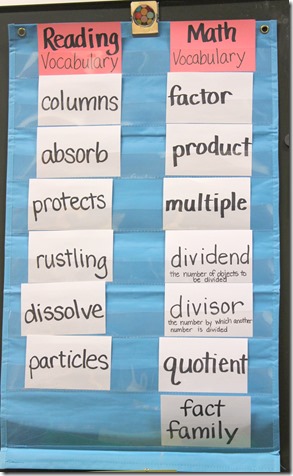
Mini-Lesson 3: always starts with quick vocabulary work. You can read more about my vocabulary routine here. From there, we usually spend some time digging into text together- either the weekly basal story or a common text, like our Time for Kids magazines.
IMG_9440

Round 3: This one is usually cut shorter because mini-lesson 3 almost always takes longer than 15 minutes- but that’s okay. Round 3 is usually when I pull students aside with their book box and reading notebook for 1-on-1 conferring and assessment. I like to use their numbers in my plans for anonymity but also space purposes!
IMG_0088

I’ll post soon about what my kids are doing during the rounds, but in case you’re thinking…

There’s no way my kids could do that! The Daily 5 doesn’t start on Day 1, or sometimes even in Month 1. Setting up the Daily 5 takes a lot of time and patience, but it’s possible! If you need information on how to get started, please please please go to the source and read the original books!


Isn’t that a lot to fit in? ABSOLUTELY. But teaching in “mini-lesson” format with time blocks forces me to cut my lesson down to the most important parts, the short time frame helps my students pay attention the whole time, and what’s happening during the rounds is so important that it’s absolutely been worth it in my classroom.

IMG_0251

Does it happen every day? Heck no! This is the general schedule, but sometimes we do two rounds, one round, or even no round on a super busy day (but students do get upset when this happens)! Occasionally we fit in an extra reading round, which most of them LOVE!

Is the Daily 5 even worth it? Running the Daily 5 has really simplified my reading preparation because I’m not creating and setting up new centers each week, but even better?

My students aren’t just doing “reading activities”- they are really READING!

IMG_0226

If another teacher questions the program, ask them if their students are spending 45 minutes a day reading. My kids are. The Daily 5 has made them better readers because they are reading so much and I am getting so much time to differentiate instruction. I wouldn’t be able to do that, though, if I didn’t keep my data in my teacher binder.

how to create a teacher binder ~ luckeyfrog's lilypad

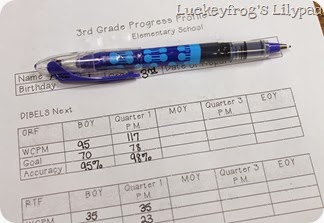
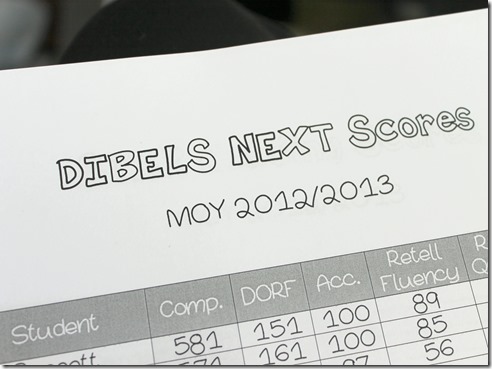
Both schools in which I’ve taught used DIBELS as a quick indicator, especially for reading fluency. It’s not near as useful as a student’s book level for comprehension, but DIBELS Next makes a great quick check and helps me formulate small groups- when the data is organized.

To help you this year, I’ve created DIBELS Next Organization Charts for grades 2-6. The charts list the tests in order and the goal for each test to hopefully help you organize your data to guide your reading block, no matter how it’s set up!

Blog- DIBELS Cover Preview

The best news? They’re FREE! Visit my store here to see charts for 2nd grade, 3rd grade, 4th grade, 5th grade, and 6th grade. Each one includes a chart for BOY, MOY, and EOY with grade level goals listed for each test section.

Blog- DIBELS Doc Preview 1

If you’re a new friend, make sure you check out some of my other freebies both on the blog and in my store before you click on the button below to head to Primary Inspired for the next freebie!


(Did I mention there’s a $75 gift card giveaway at the end? I bet you ALL could use $75 to help with your back to school shopping (or help make up for it! :) Happy blog hopping!

Wednesday, June 6, 2012

Word Detective Center FREEBIE!

I love centers that are easy to use over and over again with only slight changes. For me, my Word Detective (or Book Detective) center is just that. This wasn't an original idea of mine, as there are adorable Word Detective books at Patton's Patch and at Ladybug's Teacher Files, but I did change it up a bit.

Word Detective is a center where I ask students to find a certain kind of word. Sometimes it's a part of speech we've been learning about. Sometimes it follows the spelling pattern we are learning about. We can look for plural nouns, linking verbs, ee/ea words, possessive nouns, onomatopoeia... anything!


I have them look in books, but you can also let kids move around the room and look for words on the word wall, on labels, and anywhere in the room you have words posted!

Finding the right format did take me some time. As cute as the books above are, I wanted to be able to be able to grade them a little easier, so I switched to just a page. I plan on keeping my copies in a laminated manila folder with the flaps cut off and a red "CASE FILE" stamp on it!


The nice thing about this center is that the kids always know what to do, and they just have to check what they are looking for each week. (And it applies to almost ANY kind of word we might be learning about!)

Next year, to simplify the process even more, I plan on laminating this "Word Detective" sign so I can just write in the new thing to find each week with a dry erase marker. I can make lots of copies of the recording sheet ahead of time and only have to change this ONE thing each week. SUCH an easy literacy center (or literacy workstation, or Word Work activity!


I made the center a bit more fun by adding little magnifying glasses! (So much more fun to be a 'detective' with magnifying glasses!)

You can find 12 of these for less than 3 dollars at Wal-Mart in the party supply section.

I recently showed this center (and my others) to a co-worker who found another way to make it fun! Now, clearly, I don't have a 2nd-grade-sized head, but look at this adorable detective's hat! I hope my 3rd graders are still young enough to have fun with this!


And- so sweet- when my friend bought these, she got two for me, too!

I love my co-workers! :)
(And low-maintenance literacy centers for word work!)
Click here or on the pictures to get your freebie- copies of my Word Detective center sign and recording sheet.

Saturday, April 28, 2012

Easy, Organized Center Storage

Whew! The end of the year is CRAZY. I have some new followers, and I am excited to check out your blogs... but that just isn't happening right now with all of the things to be done at the end of the year! I promise- I will check them out when I can!

I am not a naturally organized person, as I've told you before. When I started downloading freebies from other teaching blogs, I needed a way to keep track of them all. Literacy center storage, especially, was a challenge.

Here's my solution for storing centers and keeping centers organized!

First of all, if it's something I'm looking at at home, I save it to either Google Docs or pin it to Pinterest (follow me here) so I can find it easily again at school.


(Would anyone have an interest in hearing how I organize my Google Docs?)

Once I print it, I laminate everything including the recording sheet, if there is one. Laminating the original helps me keep kids from using it, and it helps it hold up to (hopefully) years of copying. I can actually still run it through the automatic feed on our copier!

The cover sheet, if there is one, goes on the front of a manila folder. Eventually, I would love to laminate my folders, too, and just cut a slit for the opening with an X-acto knife, but it hasn't happened yet! Maybe this summer?


If there is a directions sheet (separate from the cover), like this free possessive nouns sort from Pitner's Potpourri, it goes on the back of the folder.


Inside, I put the laminated recording sheet and enough copies for my class (with a couple of extras because someone inevitably loses theirs or accidentally does it twice...)


All pieces go inside, too. Usually, I try to put small pieces in a Ziploc bag. Otherwise, they tend to get mixed in with the papers.


(Isn't this an adorable free nouns, verbs, adjectives sort from Tales of a Teacherista?)

Since the little claspy things don't especially hold up well, I don't bother using them.

Once the center is ready, I just store the envelope. Right now, I'm using a plastic filebox and they just stick out of the top. This worked this year, as I was a new teacher just starting to print/laminate all these wonderful freebies. I need to come up with a better solution for next year, though, especially so I can sort them into different topics/ holidays. I could just get more of fileboxes, but I'm open to other suggestions!


Because so many of my math centers are just one page games with no extra pieces (except for dice and counters), those centers are put into a binder and kept in plastic page protectors until I need them.

When it's time to use a center, I just pull out the manila envelope, copy the recording sheet if it's not already done, and stick the folder in the cheap plastic basket at that center spot. If students will need dice or counters, they know where to go and get them in the classroom. I keep them in little cups for easy storage!


I love storing centers in these envelopes because everything is already together and easy to move around the room. The students know that everything they need is in the folder, and everything goes back in the folder when they are done.

How do you store all your center materials? I am always looking for center organization tips! :)