photo Image277_1x1_zps92a4c832.gif photo Image277_1x2_zps82501ae2.gif photo Image277_1x3_zpse2f7619b.gif photo Image277_1x4_zpsbfd3d820.gif photo Image277_1x5_zps55244bd5.gif photo Image277_1x6_zpsa94012cf.gif
Showing posts with label classroom tips. Show all posts

Thursday, June 30, 2016

The Hardest Thing About Teaching

Most people who aren’t teachers (or in teacher families) don’t acknowledge that this job is challenging- and it ABSOLUTELY is, in so many ways."

For me, the biggest challenge in teaching is that the work never ends.

grading bag

Am I the only one?

I care so much about my students. And that is an AWESOME thing. And I love what I do! There’s something so satisfying about finding ways to teach each lesson better, and something so rewarding about finding ways to connect to each and every student I teach.

But that means that I am never, ever, ever DONE.

I could work on “school stuff” for 24 hours a day, 7 days a week, and I would STILL think of something else I could be doing for my kids.
And while it’s wonderful to be so invested… it’s exhausting to go in before contract hours, work hard all day, stay another hour or two, and then bring a teacher bag home. It’s not fair to my husband when I’m grading while we watch a movie “together.” It’s not showing my family how much I love them when I spend our entire Sunday working on lesson plans instead of spending quality time with them.

And worse? I STILL beat myself up for feeling behind, and for not doing enough.
Surely that sounds familiar to some other teachers, too?

For so many people, New Year’s Day is a fresh start- but for me, the time for resolutions is back-to-school. And every year, I tell myself I’m going to finally be organized, not procrastinate, and not live at school.

Last year, I finally did a little better. I’ve still got a LONG way to go- but I cut back so much on the hours I spent on my classroom, and it’s all thanks to Angela Watson. She started a course called the 40 Hour Teacher Workweek Club.

Angela Watson's 40 Hour Teacher Workweek Club: Learn how to choose a target number of hours to work each week and stick to it! You'll discover work/life balance strategies, productivity tips, and more. Bonus: There’s a private Facebook group where you can ask questions and get the support of other teachers as you create new routines that are sustainable and take back your weekends!

Of course, 40 hours sounds nice- but the goal of the group isn’t about any specific number. It’s about streamlining and building efficiency as a teacher so you can spend less time working without being a less effective educator.

Here are some of the things I changed:
  1. Always make a To Do list before the morning.
    If I come in with the list ready, I don’t have to waste one second thinking about where to start. Even better? I don’t forget as much. Sometimes, this is as simple as a Post-It- but it sets the pace for my day in such a powerful way.

    list


  • Make a better To Do list.
    I’ve always been a list-maker- but by thinking about the gaps of time I actually have in my day and how much I can fit into those specific times, I tend to schedule smarter and make myself more accountable for not wasting moments here and there. When I took the time to plan out my whole week, things ALWAYS went better for me!

    lists
  • Stop overestimating what I can get done.
    When I look at the actual time available and I try to schedule within that, I am a lot more fair with myself- so I’m not so hard on myself when the list of 30 things doesn’t get done. And I  try to give myself credit for the multitude of things that come up unexpectedly. It’s not just about what I actually get done, but also how I feel about it.

    all

  • Lower my standards.
    This sounds like such a bad thing- but it’s all about finding a place where YOU put unnecessarily high standards on yourself in ways that don’t really affect the students that much. It’s about identifying those little things that only really bother YOU- and learning to let go, and cut yourself a break. Sometimes simple things work just as well.

    simple
  • Put other people to work.
    It took some time to realize that I was putting way too much on myself. I started relinquishing some control and letting my students pitch in more. And by streamlining and making some of my routines more efficient, I was finally working ahead just enough to utilize parent volunteers for some tasks! (These work request forms are from Firstie Kidoodles- you can snag them for free here!)

    copies
  • Batch EVERYTHING.
    One of Angela’s big tips is to “batch” big tasks- doing similar tasks all at one time so you can get in a groove and don’t waste a lot of transition time. Whether it’s doing most of my copies on one day instead of trekking back and forth each morning, or grading on one evening instead of a few minutes here or there, batching has made a big difference in me getting things done without feeling like I’m constantly working.

    batching


  • These are some of the BIG ideas, so maybe they don’t sound revolutionary- but they are much easier said than done. Angela’s club content goes into so much detail about specific strategies, and offers printable resources (like the To Do list above) to make implementing each change easier.

    If you’re hearing about the 40 Hour Teacher Workweek Club and feeling too overwhelmed to start one more thing, I completely get it. As a VERY “Type B” teacher who already felt like there weren’t enough hours in the day, I was hesitant to join a course. But I had read Angela’s books and her blog, and I knew she had a lot of helpful tips.

    More importantly- I thought if there was even a chance of getting more of my life back, it was worth investing in.
    The 40 Hour Teacher Workweek Club: What's YOUR target number?
    (And Angela offered a money-back guarantee too, which helped with my skepticism!)

    Once I joined, I started getting weekly articles from Angela. She sends an audio version, too, so sometimes I save time by downloading it and then listening on my commute. Even when I wasn’t able to read or listen that week, it was no big deal- all of the content gets archived on the site to access whenever I do have time to get caught up.


    Besides the e-book content, one of the best parts of joining is the exclusive Facebook group, full of hundreds of supportive teachers who give suggestions, ideas, and encouragement. You are not alone in being overwhelmed sometimes by this rewarding but difficult job.

    The group isn’t about being perfect, or about completely changing everything that you do. It’s about small steps that add up to BIG changes- and for me, the 40 Hour Teacher Workweek Club has made a huge difference.

    I can’t wait to make more changes this year and spend even more time with my family. As important as teaching is to me, I need to learn strategies for better balancing my priorities so I can give my family the time and energy they deserve from me- and so I don’t burn out!


    If you’re thinking you might need this too, be sure to check out this post from Angela that will give you tips for making the most of your summer- and give you a better idea of what you can expect in the 40 Hour Teacher Workweek Club!
    --------
    P.S.- In full disclosure, I am an affiliate of the program, but I’m sharing this because I’ve been a member myself since October and I really believe in it. My husband commented on how much more he sees me, and I even convinced my mom to join!

    P.P.S.- If you are interested, be sure to check it out SOON! The club only opens enrollment twice a year, and this will be your last chance to join until December.

    Sunday, July 26, 2015

    Classroom Supply Organization for Departmentalized Teachers

    Back-to-school time is always a little crazy, but a few of my upper elementary blogging friends have teamed up to share some of our back-to-school tips and tricks!

    Last year, I moved into a departmentalized 4th grade classroom for the first time. I love getting a chance to really focus on teaching science, but seeing 125 students instead of 25 really changed the way I set up my classroom! Today I’m sharing supply organization tips specifically for departmentalized teachers (although many of them would work in any classroom!)

    Slide1

    I set up these Sterilite drawers at the end of each table, and they are a lifesaver! Everything my students need on a regular basis is in these drawers. Because they switch classes, it’s really helpful to have the glue, scissors, markers, and crayons here (rather than having them carry their own). The bottom drawer holds our science textbooks (the drawers struggle a little with that much weight, but we don’t actually get them out much), and the top drawer holds small whiteboards, dry erase markers, extra pencils and erasers, and sets of markers.

    IMG_5571   IMG_5594

    Having the markers in individual “sets” made it so much easier to find text evidence in the passages from my Text Detectives (for 3rd grade and now 2nd) and Colorful Close Reads. This year, I’m keeping an eye out for travel soap containers so I can store my crayons in  similar way. I love Crayola, but those boxes just do NOT hold up!

    IMG_7373

    Last year I used shower caddies instead of these smaller craft caddies. They held a little more, but they hung over the sides of the white drawers and sometimes my students would bump them… and of course, everything would fall all over the floor.

    IMG_5499   IMG_5555

    My solution this year was smaller caddies and Velcro on the bottom. (I start with both Velcro dots on to make sure they will line up.) I’ll keep you posted how it works!

    Slide2

    My kids have science notebooks that stay in our classroom, and sometimes last year one was left behind. Despite sticker labels, it sometimes took a little time to figure out where it belonged- so this year, I’ll be using duct tape on the spines to help easily see where it goes.

    I can use the same color-code for almost everything in my classroom, too!

    Slide3

    I store my notebooks in these Dollar Tree bins. The same color of duct tape helps students identify the correct bin quickly, and once the school year gets started, I’ll write the homeroom on the frog, too. All of the bins sit on the floor under the whiteboard, in the order of when I see each class.

    Since my students come in and start their day with a Science QuickWrite, I have a couple of students pass out the notebooks at the start of class. As I dismiss groups at the end of class, each group can drop their notebooks in the bin on their way out.

    Slide4

    With 5 classes of science and 1 class of social studies, I occasionally struggled to keep up with make-up work. While my students were supposed to come pick up their work independently, it rarely happened- and then I spent time later trying to figure out what was missing.

    Putting these open folders up on the cabinet in the back of the room helped me so much! As my students get started on their QuickWrite, I take a moment to catch up with any students who have papers here- whether they are absent work, papers to re-do, or pages I kept aside for reteaching.

    Slide5

    Being a science teacher, I could spend so much time handing out materials. As much as possible, I try to keep common supplies at the supply stations and any special supplies (such as those for a lab) in a bin at the front of the room. I can simply call up one student from each group and most materials are ready within a minute!

    This also helps because I see my classes every other day. (Our kids go to reading and math every day, but during their third block, they alternate between science and social studies.) This means that I teach the same lesson for two days in a row- so being able to keep all materials in a bin makes for easy clean-up at the end of the day, too!

    Slide6

    While the “stuff” can be overwhelming when you see six classes, the paperwork can be even worse! The students each have a binder with tabs for each class, and my teacher binder has tabs for each of my classes, too.

    Once the papers are turned in, I group them together with Clip-Rite BinderTabs (shown above). I use a small class checklist to mark off whose I have, whose I’m missing, and what the scores are. (Makes it so much faster to put grades in the computer!)

    IMG_5667   teacherbinder2

    As soon as I have copies made, I keep my papers that I’ll need for teaching in the purple, blue, and green plastic drawers. (I love that they’re the 12x12 size so I can put one stack horizontally and then the next vertically!) I use the top black tray for the kids to turn in regular work, and the bottom tray for the kids to turn in anything late (make-up work, late work, redone work, etc.). I love having a central spot for any other supplies a kid might need (stapler, tape, hole punch, etc.) so they don’t have to ask me!

    There is so much to do this time of year- but hopefully these tips give you some classroom organization ideas! For more tips on starting the year off right, I hope you’ll check out the rest of the Back to School Survival Guide.

    back to school survival guide

    And to thank you for checking out our blog hop, we’re EACH giving away 2 gift cards to TeachersPayTeachers. If you could use $25 to spend on back to school goodies on TpT, be sure to enter the giveaway below.

    a Rafflecopter giveaway


    If you’d like a few more Back to School ideas (and more chances to win $25 gift cards!), please be sure to check out some of the other blog posts. Good luck as you start another school year!


    post signature

    Sunday, February 2, 2014

    Bright Ideas Blog Hop- Get Kids Moving (And Still Learning!)

    Today, I’m so excited to be part of a blog hop of great ideas- not products, not freebies, but just fantastic teaching ideas!


    I don’t know about where you live, but we have had many MANY days of indoor recess lately. With having gym only one day a week, my kids are really getting antsy!

    As a reading specialist who helps our struggling readers, I seem to see a decent number of kids who struggle with sitting still and/or focusing on the task at hand, even without the cold and snow keeping them inside.

    Here are 8 ways to get kids moving to keep their brains active:
    • Math Fact Exercise!
      Skip counting is such a valuable skill, and can be ramped up for kids of all ages. Of course, you can count by 1’s, 5’s, 10’s, etc., but what about starting at 14 and adding ten more? What about counting by 3’s when you’re learning multiplication, or by 25’s when you’re learning about money? I have my students stand and do some kind of exercise while we skip count- jumping jacks, touching their toes, jumping in place, etc.
    image
    • Brain Breaks
      My kids really enjoy the Just Dance videos on YouTube! I have a whole Pinterest board of brain breaks that get my students up and moving for 3-5 minutes, and it really helps them focus for the next hour. A kindergarten teacher I know even does the Cupid Shuffle, so her kids are counting and having to remember left from right. My kids especially love GoNoodle for LOTS of fun, interactive, and free brain breaks!
    • Vocabulary Motions
      As a bonus, tying some movement to the definition really helps my kids remember the word meanings. In my classroom, the students help me come up with a motion for the words and we run through them quickly every day. You can read more about my vocabulary routine here.


    • Chart Paper Brainstorming
      Can you let your students make a list of something? Maybe it’s proper nouns, words with short o, ways to make 10, factors of 100, or comparing and contrasting with a Venn diagram. Give each group markers, a piece of chart paper, and a section of the floor. Working on the floor always helps my class with the wiggles, and they all love to participate!
    • Tall-Middle-Small Spelling
      Have your kids practice spelling their words by thinking about where they sit on handwriting lines. For “tall” letters, like t or b, they reach hands up high. For “middle” letters, they put their hands on their hips. For “small” letters, they touch their toes. You can also have kids sit in pairs and “spell” a word with their finger on the other student’s back, and see if they can guess the word.
    • Scoot! with Dance Breaks
      Need students to get a lot of rote practice with something, or need to formatively assess their understanding? Put each problem or question on one card, and one card on each desk. Then, have the students stand and “scoot” from one desk to the other after 30 seconds or so. I sometimes turn on music and let them dance when they’re finished- makes it easy for me to see when most are ready to move on, and they get the wiggles out! (You can find lots of ready-made games like this by searching for “Scoot” or “task cards.”)
    IMG_0433
    • Phonics Dance
      This is a program my school purchased, and it gives kids motions and chants for lots of common phonics patterns that they will encounter in reading. I love the way it makes phonics “stick” for my students- but it also gives them a chance to move!
    • Read/ Write/Solve the Room
      Sometimes the simple act of turning an assignment into a scavenger hunt by having students find words/ math facts/ questions posted around the room can make such a difference in how well my students can sit and focus afterwards- and they’re still getting the practice!

    • Geometry Challenges
      Give your students a challenge to make a certain shape somehow with their bodies. They can use their fingers, their arms, their legs, or their entire torso- but somehow, can they make a square? A trapezoid? An isosceles triangle?  Making geometry interactive is so much fun!
    Love finding ways to get my kids moving AND learning!

    Next in the hop, you’re headed to Matt of Digital: Divide and Conquer, who’s sharing a simple tech tip for your classroom!

    Digital: Divide & Conquer

    You can click to some other bloggers here:


    post signature

    Tuesday, November 12, 2013

    Giving THANKS for Teacher Time-Savers!

    I’m teaching half-time this year and still feel like I never have enough time to do everything I’d like to do! I’ve figured out a few ways to save time as a teacher and they really help me fit it all in. Here are some time-saving tips that you might be able to bring to your classroom!

    1) Create your own forms for anything you create on a regular basis.

    Luckeyfrog's Lilypad Lesson Plan Template

    My lesson plan format saves me SO much time every single week. (Pick up free planning template and lesson plan tips here.)

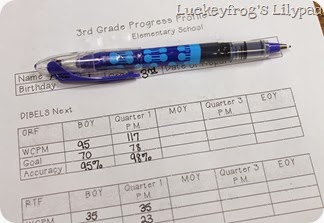
    Luckeyfrog's Lilypad Data Form for Teachers  Luckeyfrog's Lilypad Data Forms for Teachers

    Here are my data forms from last year and this year- so worth the time investment!

    2) Don’t give yourself too many things to change each day or week! Remember- keep it simple!

    Luckeyfrog's Lilypad Must Do Board     Luckeyfrog's Lilypad Center Rotation Wheel

    This Must Do board was so easy to change out each week for Daily 5 Accountability, and back when I did more traditional “centers,” having a rotating wheel was SO much easier than moving a ton of cards! (I even kept centers as simple as I could, like the Word Detective center—free in my store if you don’t have it yet!)

    3) Do things ahead of time!

                                Luckeyfrog's Lilypad- student birthdays

    Okay, maybe this isn’t exactly saving time, but I like to set myself up for success later. Rather than worrying about morning work copies each week, do them ahead for a month or two. Rather than having to prepare birthday certificates and things one at a time, fill out all of the certificates in order for the year at the beginning, and then stick everything together in one spot so it’s easy to grab that morning!

    4) Use Post-It notes to move seating charts.

    Luckeyfrog's Lilypad- Post-It Seating Charts

    It’s so much easier than moving a million desks- and bonus, if you make your seating chart in a file folder and stick it in your sub folder, it’s one less thing to worry about for a sub!

    5) Use your storage to minimize transition time!

    Luckeyfrog's Lilypad- Supply Storage

    This year, as a reading specialist, the two of us who share our room put together this little supply station. It’s right next to our table, so it’s easy to grab the basket we need and put it where students can easily access supplies.

    Luckeyfrog's Lilypad- Supply Storage     Luckeyfrog's Lilypad- Supply Storage

    Last year, in the classroom, I concentrated a lot on making manipulatives easy to hand out quickly. (Shower caddy for our math journals and reading response notebooks, and Target Dollar Spot boxes for place value blocks- I can let one student from each group get their supplies and it’s quick and easy!)

    Luckeyfrog's Lilypad- Supply Storage     Luckeyfrog's Lilypad- Supply Storage

    Cups, bowls, recycled materials, and of course Target finds worked really well for easy, cheap, stackable storage. The ones below were perfect for when my students played games—everything they needed in one easy grab!

                                                Luckeyfrog's Lilypad- Supply Storage

    6) Put frequently dialed, important numbers right on the phone so you never have to look them up!

    Luckeyfrog's Lilypad- Teacher Time-Savers

    Also PERFECT for subs- just in case someone gets sick or they have a question.

    What are your time-saving teacher tips?

    Link up your time-savers with Blog Hoppin’!

    Tuesday, March 12, 2013

    Managing Library Books- Easily!

    I love my specials teachers. My kids go to music, art, gym, and library each week.

    IMG_8016
    This sign from Ladybug's Teacher Files. My room is slowly being taken over by her products :)
    Library is sometimes tricky because in a half hour, kids need to return or renew books, learn from a lesson, and pick out and check out new books. Our librarian has terrific parent volunteers that help with checking books in and out while she teaches, but she also has some great management ideas that make it all run smoothly.

    Each class has a rolling cart labeled with the class name.

    IMG_8017

    I slide this under a table during the week and pull it forward on library day, complete with a bright sign (just construction paper folded over with some tape to slide over the handle) to help kids remember to turn in their library books on Thursdays.


    IMG_8018

    Easy peasy.

    IMG_8019

    If someone wants to renew a book, they can tape this little note next to the barcode. (Another teacher showed me this- brilliant!)

    IMG_8020

    Our class librarian brings the books down just after the announcements, so a parent volunteer can start checking books in even before our library time.

    It’s seamless! We also have lunch bins like the one below for lunch boxes to be easily toted to the lunchroom (since our kids go straight from recess to lunch) and easily toted back to the room by our Lunch Bin Movers.

    IMG_7940

    I love that people at my school have come up with such great solutions to “stuff” problems! Do you have anything like this to make your daily routines more convenient?