photo Image277_1x1_zps92a4c832.gif photo Image277_1x2_zps82501ae2.gif photo Image277_1x3_zpse2f7619b.gif photo Image277_1x4_zpsbfd3d820.gif photo Image277_1x5_zps55244bd5.gif photo Image277_1x6_zpsa94012cf.gif
Showing posts with label blog hop. Show all posts

Friday, July 17, 2015

Daily 5 Foundation Lessons- Chapter 6 Book Study

When friends have asked me about the differences between the first Daily 5 book and the second edition of Daily 5, one of the big ones for me is the detail to the foundation lessons and the lesson plans of the first few days. I feel like this edition is much easier to implement!

Chapter 6 was all about the foundation lessons you teach to prepare your students for each Daily 5 task. By teaching these foundation lessons, you set your students up to be independent and successful… because it’s all about setting the expectations for your kids.

When I read them this time, it hit me.

These aren’t just foundations for Daily 5!
These are foundations for a productive, independent classroom.

Think about it- choosing a “successful spot” or choosing a good working partner lessons are really perfect for any time of day. I always try to empower my students with the responsibility of choosing a good spot when they come to sit at the carpet, or choose a partner in groups- because it asks my students to know themselves as learners and be aware of what works for them.

This is important to me because we are NOT all the same. My mom is a get-it-done-early, sit-at-a-desk, focus-on-one-thing type person. When I work, I prefer to be on the couch with a favorite show (currently Gilmore Girls) on in the background, and usually, I’ve procrastinated- but then I keep tweaking it until it’s perfect! It’s just a different style.

Some of my kids prefer to sit at a desk, where they can have their book on one side of the desk, their notebook on the other, and an easy surface on which to write.

Other kids want to be curled up on a beanbag in the weirdest positions, with a book in the air and their fingers tapping and toes wiggling the whole time.

library1

(This was a picture of my not-quite-finished library at my old school- plenty of different areas for kids, with a few rugs and other areas around the room!)

In any case- it’s important for our kids to figure out what works for them so they can be independent readers and learners even when an adult is not telling them what to do. It also builds a culture of responsibility for our choices.

I always talk with the kids about my own friends. I have some friends I just love, but I know I could not sit next to during an important staff meeting- because we’d be distracted, talking and giggling to each other the whole time. They seem a little shocked that I might ever “misbehave”- but I want them to understand that we are ALL human, and we ALL have to make choices that help us be successful.

Ultimately, these foundation lessons are teaching our students decision-making strategies. I’ve always looked for ways to do this (one of my very first blog posts was about teaching students to use Rock, Paper, Scissors in the classroom!)- but Daily 5 does it in such a structured way.

The foundation lessons also support my very first science lesson of the year- all about our brain, and how we should constantly be working to make our brain stronger.

Teaching our students about growing in stamina and about how to work with a partner are so powerful because they give ownership over students’ own learning. I think my favorite is the “Coaching or Time?” lesson for Read to Someone. In it, students learn that they should give someone a few seconds to try a word before chiming in (or, as I tell them, “give your partner a chance to make their brain stronger”) and then offering two kinds of help. The student can choose if they would like coaching or more time to help them decode the word.

These foundation lessons support my class through every subject, but they’re also vital to making sure my students are independently focused during Daily 5 so that I don’t have to stop my small group and individual instruction!

These foundation lessons are especially important for Listen to Reading and Word Work because of the materials. The materials for Listen to Reading may be tricky to navigate at first- but teaching students how to use them but also how to get them out and put them away is huge.

computers1

(Our Listen to Reading station!)

And in Word Work? These were what my students considered to be “fun” materials- so it was especially important to teach the expectations and practice them repeatedly.

Of course, the specific, reading-based lessons are important… but my big takeaway from this chapter was just how much Daily 5 contributes to student success all day. If you want details on the foundation lessons taught, I’d definitely suggest getting the Daily 5 book!

You can also read more from my friends in the book study, starting with our host from Sarah’s First Grade Snippets! She has a great primer on all of the Daily 5 foundation lessons : )

Sarah's First Grade Snippets!

[Note: This post contains affiliate links.]

Sunday, July 5, 2015

Shark Week Blog Hop

All teachers know that kids learn more when they’re excited and engaged. Today Matt from Digital: Divide & Conquer and I are hosting a team of bloggers to help your students take a BITE out of learning with a theme your students are sure to love!

Slide6

 My Shark Week freebie is a few shark-themed passages for about grades 3-5. Together, the three passages guide students in analyzing genre, while still including some general annotations and reading comprehension, too! After reading the three passages, students complete a short written response that forces them to compare and contrast the passages.


I am REALLY excited to try this out with my class- and I can't wait to hear what you think!

fintastic freebie

Click on the photo below for Colorful Close Reads: Shark Attack! Genre Study.


Be sure to go for a swim and visit Hilary at Rockin' Teacher Materials for the next free resource!

http://rockinteachermaterials.blogspot.com/2015/07/shark-week-blog-hop.html

Every blog in the Shark Week Blog Hop features a jawesome freebie for you and your students- but hurry! Shark Week only lasts until Sunday, July 12  : )


Sunday, February 22, 2015

A Spark of Inspiration Blog Hop

Happy weekend, teacher friends! If you’re new here, I’m Jenny, a 4th grade science and social studies teacher who loves integrating language arts across the curriculum. Thanks to Sarah from Sarah’s First Grade Snippets for sending you here!

Sarah's First Grade Snippets!

While I was in college, I started reading teacher blogs. I discovered a new world of learning and inspiration- and I quickly realized I wanted to be a part of this world.

Now that I’ve been blogging for a few years, I feel so fortunate to also collaborate with some of those amazing teachers from around the country.

If you’ve been a reader of our blog A Class*y Collaboration, we’ve updated the look and name to match exactly what we want to give you- A Spark of Inspiration!

A Spark of Inspriation

I know you may be thinking that reading another blog takes time- but this is a good one! To give you a taste of what you’ll find over there, here are photos from just a few recent posts:


Plus, if you live anywhere near me in Ohio, the weather is cold and snowy enough that staying in to read teaching ideas is pretty ideal! (Can you say wind chill of –20? Brr!)

2015-02-18 10.33.20

To thank you for checking out the new blog and to help ring in spring weather, each one of our authors is offering a quick freebie- and the chance to win some serious gift cards!


I’m sharing a sample of my newest resource that’s juuuust about ready for TpT- Text Detectives Jr.! Like my original Super Text Detectives series, your students color-code text evidence to answer comprehension questions… but the original set is written at about 3rd grade level (independent) , and the new Text Detectives Jr. sets are about a 2nd grade level! March’s full Super Text Detectives Jr. pack should be posted in my store by early next week- but you get a sneak preview!

Luckeyfrog's Lilypad- Text Detectives JR- March Sampler

The passages in TD and TD Jr. have similar content and similar questions so that you can use the two packs together for differentiation in your 2nd or 3rd grade class, too! Click on the picture to download your free sample passages!

You can read more about how I use them to teach my kids how to find text evidence here. When I was a reading specialist last year, my students LOVED these- and they really helped them learn, too!

2014-03-26 22.44.43

Thanks for stopping by my little corner of the Internet  : ) Be sure to check out each blog to grab some freebies and enter our giveaway… starting with Megan from Mrs. Wheeler’s First Grade!


a Rafflecopter giveaway

Tuesday, January 6, 2015

Winter Wonders Freebie Blog Hop

Whew! Today was my first day back, and I have to say that I was not ready for an alarm before 7:00… but I got up, got ready, and after enduring some sad faces from my dog and a frozen-shut car door, I got to school.

I was having a hard time getting in the groove, and then the kids came in… and I remembered why I do this!

The winter blahs are tough sometimes, but my friends from the Adventures in Literacy Land blog are here to cheer you up with some Winter Wonders freebies to celebrate our one year blogiversary together!


Today our group of reading specialists, literacy coaches, and Title I teachers are sharing some short posts and free literacy resources for you- so be sure to follow the link at the end of my post to the next one! At the end of our “hop,” you can enter to win a Barnes and Noble gift card!

When a struggling reader is told to go back in the text, you can see their face fall. They JUST pushed themselves, and maybe embarrassed themselves, to make it through the text- and you are asking them to go BACK? Are you kidding?

Slide3

Telling kids to go back in the text with no extra guidance is a surefire way to make sure that they ONLY do it when you’re watching. Struggling readers need a method to the madness!

Last year as a reading specialist, I worked with so many kids who didn’t want to stop in the middle of the reading, because it slowed them down even more- but without me slowing them down, they were thinking about the next word, and not about how that word fit into a sentence, how that sentence fit into a paragraph, and so on. They couldn’t build meaning as they read.

We practiced stopping after each paragraph to write the topic off to the side. It wasn’t even a summary, really- just a few words to answer, “What was this paragraph about?” By jotting it down, my students had an easy reference- almost like a table of contents for their passage.

Slide4

Then, when we finished it, we glanced back at the topics. It’s a quick way to recap the text’s main ideas.

By the time we get to the questions, we know what each PART of the text is about- which makes it so much easier for kids to predict where to look for the answers to the questions. Oh, it's talking about where George Washington was born? That's probably in the paragraph about his childhood- and now I know where to look first.

Of course, our predictions aren’t always right- and it’s important to model that for kids- but stopping as students read to really get them thinking about the big ideas of the text helps give them somewhere to start.

When you’re not a strong enough reader to scan and quickly find the answer in a large piece of text, a strategy that gives you somewhere to start drastically increases the likelihood that you’ll even try looking back in the text.

And while this is a great test prep strategy, it’s also fantastic for real-life applications like research that require looking up specific pieces of information and even deciding which Google result to click on in a search.

Want to try it out? I’m sharing a free snow-themed sampler of my Text Detectives series for finding text evidence!

snowsampler

download here }

IMG_7530

It’s my students’ favorite way to practice finding answers for “right there” questions in text, because they get to color! I aim for about 3rd grade reading level, although it works well in 2nd –4th. You can read more about how I use them in my classroom here.

Next, hop over to Deniece at This Little Piggy Reads for the next Winter Wonder!


Thanks for stopping by!  Don't forget to hop all the way to Adventures in Literacy Land to enter our giveaway and welcome our new members! Happy Winter!

post signature

Saturday, April 12, 2014

Bright Ideas- Post-It Races

Sure, we’ve all used Post-Its, and loved them- but today I’m sharing a way to use Post-Its that you might not have tried before!

Welcome to the April edition of the Bright Ideas! As always, this link-up is meant to help you discover some amazingly simple, absolutely free ideas… and some awesome new blogs, too!

bright ideas 2.001

Two years ago, my students were learning the names of the continents, and some were really struggling. Our map didn’t make it easy to read the continent names, so I made labels using Super Sticky Post-It Notes.


To practice identifying continents, we simply mixed up the Post-It notes and I challenged students to put them on correctly as quickly as they could. We called it the Post-It Place Race- and the idea could work for identifying continents, countries, states, etc.

This year, I started looking for ways to apply this kind of interactive practice with Post-Its in other ways. Some ideas:
  • matching vocabulary to definition
  • matching shape/ solid names to their pictures
  • matching color words to colors
  • matching number words to numerals
  • labeling parts of a book (cover, table of contents, title page, etc.)
  • labeling text features in non-fiction
  • labeling parts of a plant, cell, human body, etc. in science
  • labeling parts of a friendly letter
  • labeling or matching basic classroom nouns for ESL students
  • filling in “missing” spots on a hundreds chart or “missing” letters
  • ordering the days of the week, numbers, story sequences, etc.
  • fun test prep!
  • and… anything else you can think of!
This year I’m really enjoying using this strategy on an anchor chart- so it can hang in our room as a reference, but still be used for practice at a center, during whole group instruction/ review, or with small groups who need extra reinforcement of a concept.

I do recommend the Super Sticky notes because they tend to hold up a little better to repeated placing and removal : ) but other than that, the possibilities for this simple teaching strategy are endless!

I’d love to hear your ideas for using Post-It Place Races in your classroom!
Interested in more ideas to simplify, organize, and inspire your teaching? I’d love to connect with you on Bloglovin, Facebook, and Instagram : )

Make sure you browse the rest of the Bright Ideas Link Up below, too! 150 bloggers are sharing helpful ideas, labeled by title and grade level to help you find the perfect ones for YOUR classroom. Read, pin, and get inspired for the home stretch!


Sunday, March 9, 2014

Bright Ideas: Tips for Organizing Progress Monitoring Materials

It’s time for another Bright Ideas Blog Hop!

Blair Turner's photo.

Last time I was amazed at the wealth of knowledge shared, so be sure to hop through or browse through the linky at the bottom to find some new ideas to make your life easier as a teacher!

This year, I’m a reading specialist for 2-6 one half of the day, and a Title I teacher for kindergarten the other half of the day (at different schools). Organization has always been a challenge of mine, but this year it’s been impossible not to keep my progress monitoring materials and data organized.

For progress monitoring, I keep a binder for each measure. For instance, we share a big binder for AIMSweb passages at one of my schools. We have tabs to separate grade levels, and then we keep the ORF student copy on one side of the page protector, and the teacher copy (with numbers) on the other side. At my other school, I organize my EasyCBM Letter ID and Letter Sounds measures back to back, so that all of my week one materials are in one page protector and I just have to flip it over in between assessments.

IMG_0088

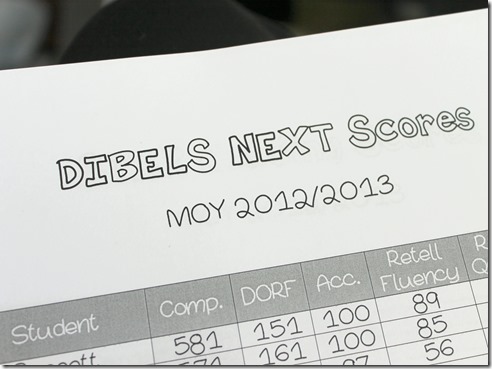
I keep track of my official data for the class on a data sheet like this one I made. (Picture from last year, when we used DIBELS. Yes, I know ALL the tests now, haha.) I know this feels like one more thing to do, but like with my lesson plans, making the form that fits what I need at the beginning of the year is so helpful!

IMG_9141

I also keep a sheet in my teacher binder for each student that I update just around grade card times or before conferences. It is absolutely vital for parent teacher conference organization!

For anecdotal notes, I kept it very low-tech and used basic supplies you already have:

photo (17)

I flip the index cards over and write the students’ name or number on the edge of the card.

photo (19)

Then, I tape it down from the top on the very bottom of the file folder.

photo (20)

I layer the next card over it so just the name is showing.

photo (21)

And keep going…

photo (22)

And finally, I put a cover for the teacher’s name (or group time, boy/ girl, etc.) on the top of each group.

photo (23)

When I am finished adding for each class, I can easily flip to the kid I need- but the notes are always covered & secure.

photo (26)

When I fill a card, no problem- I just put a new one in its place and file the filled one away in my student folders. I might also use scrapbook paper and/ or washi tape to cute this up- but I was in a hurry and this only took me a few minutes to pull together!

photo (25)

All of my notes fit in this one folder for the entire afternoon- and if a teacher asks about that kid, it’s easy for me to instantly flip to that kid’s notes.

photo (27)

This could work for academic notes, behavioral, workshop/ CAFE conferencing, or pretty much anything YOU need- but it’s a simple way to keep anecdotal notes at your fingertips!

Next up in the link-up, you can find some new, fabulous writing ideas from The Bubbly Blonde.

The Bubbly Blonde

Thanks for stopping by!


post signature

Friday, January 31, 2014

Loving Literacy Blog Hop–Stop #18 (and a FREEBIE!)


Welcome to...
luckfrog.stop18
As Valentine's Day draws near, some literacy-loving friends of mine decided it was the perfect time to share what we love so much about reading!
Each blogger participating in this weekend's hop is sharing materials for his/her favorite book, book about friendship, or for Valentine's day.  We hope you'll enjoy using them and sharing your love of literacy with your students.
I have always loved reading, for as long as I can remember. In my books, I could ride a horse with the Saddle Club, learn about animals with scientists, hang out in a boxcar with the Boxcar Children, or sneak around town like Harriet the Spy. I was the kind of kid who would get in trouble for reading when I was supposed to be cleaning my room, the kind of kid who had to be told that I was not allowed to check out any more library books than I could carry, and absolutely the kind of girl to think I was pretty much Belle.


Okay, so I didn’t read to sheep… but I had brown hair and loved to read, so clearly we were the same person. Or maybe I just wished that. I mean, a girl like me had dreams…

Anyway. Reading was always a thing I loved! But now that I’m teaching, I see kids who don’t feel the same way, and it kills me.

Last year, my students had reading response notebooks. They were such a wonderful way to connect kids to books- and for me to connect with my kids, too. Our notes back and forth in the notebooks helped them become this sacred, trusting space where kids could tell me anything.

IMG_9491

One student wrote that she didn’t like books where everyone had such perfect lives. They had their moms and their dads and their house and a pet, and never had to worry about having enough for dinner or someone overdosing on drugs.

This girl had been through a LOT- and my heart ached to read her note, but I knew she was just not a kid that could connect to a silly Junie B. Jones book.

I suggested Love, Aubrey. It was a little hard for her reading level, and included some deep family struggles- content that I might not suggest to every third grader, but for this girl, it was the right book.


She read it and immediately connected to the main character- and yet, the book holds onto suspense and doesn’t tell you exactly what has happened in this girl’s past.

She was hooked. And not hooked because all her friends were reading it, or because it was funny and silly, or even because her teacher suggested it- but because she had finally found a character with whom she could empathize. In a school where most of the other students had no experience like hers, this girl found solace in the fact that she wasn’t alone- all from the perfect book.

THIS is what I love about reading, and especially about teaching it.
Reading can change kids, and make their differences okay. I wrote a quick mini-unit for a new book called Exclamation Mark.

IMG_0413

This book is all about learning to love yourself for those things that make you stand out. It’s also a fantastically crafted book- full of simple but powerful illustrations, brilliant wordplay, and fun dialogue that kids just love. 

Because I know we have such a wide range of teachers on this blog hop, this unit offers differentiated pages for young students to upper elementary.

IMG_0417

Plus, these personalized exclamation marks and writing make a great craftivity to display at parent-teacher conferences! They are a great way to show "you"! If you'll excuse the lack of artistic skill, here's mine:


We actually used the exclamation marks on our first day with our groups- from grades 2-6!
This Exclamation Mark unit is available now in my TeachersPayTeachers store. I hope if you like what you see, you'll stop by again sometime to make sure you catch future freebies while they are still free!
-click here=

Thank you for coming by! I would love to hear some of the books YOU love for teaching kids to love themselves! :)