photo Image277_1x1_zps92a4c832.gif photo Image277_1x2_zps82501ae2.gif photo Image277_1x3_zpse2f7619b.gif photo Image277_1x4_zpsbfd3d820.gif photo Image277_1x5_zps55244bd5.gif photo Image277_1x6_zpsa94012cf.gif

Friday, October 25, 2013

Super Sleuth Blog Hunt- Stop # 10


Finding Text Evidence


In my new position this year as a reading specialist, I am sometimes amazed to see 2nd graders through 6th graders struggling with the same skills! One big skill that my kids need work with is finding textual evidence to support their answers to basic reading comprehension questions.

My kids are bringing in schema and making connections, but they struggle to tie their answers back to the text, which is such an important skill! Now that Common Core has brought an extra emphasis to text evidence, our teachers are really focusing on giving students structured practice defending their answers in the text.

Of course, we eventually want students using clues from the text to infer, analyze, evaluate, and draw conclusions, but many of my students are still struggling with the basics of finding the direct, explicitly stated evidence in the text- so I created this Color-Coding Text Evidence mini-pack.

Super Text Detectives- color-coded text evidence from Luckeyfrog Learning

After trying these out with my students this week, I would LOVE to know what you think- and if they work well for you, monthly sets for the whole year (or bundles!) can be downloaded in my TpT store!

If you’re new here, welcome! You may want to read a little about me, check out my free customizable lesson plans, view some new teacher tips, or find a few more freebies! I’m a 2nd/ 3rd grade teacher turned reading specialist for grades 2-6 who LOVES integrating science and social studies into my teaching- and blogging to share ideas!

If you care to follow along, you can follow my blog here:

Bloglovin Button

You can also find my email, Facebook page, TeachersPayTeachers store, and more on the top right section of the blog. I hope this freebie helps you and your students!
Now for your clue! On your form, you can record the letter...

Red Letter O

{Don’t have a form? Make sure you look below at the link list and go to Comprehension Connection, our first stop. You’ll find out more about our giveaway and pick up your clue-hunting guide to make sure you don’t miss ANY of the freebies!}

Thanks for visiting today! Now you’re off to visit one of my favorite bloggy friends, Emily over at Curious Firsties. Click below to head to your…


(Map of all stops included below- just in case you get lost during the investigation! :)


Thanks for stopping by! :)

Tuesday, October 22, 2013

Exciting News!

Two quick notes!

One- I'm featured today over at Principal Principles!

Principal Principles

If you haven't checked out Stephanie's blog, I absolutely recommend it. I'm a little jealous of the teachers in her school-- how great is it that they have a principal who blogs and specifically looks for ways to feature the great teaching she sees within her walls (and outside of them, too)?

She shares a wealth of great ideas that you can take back to your classroom right away, so be sure to check out Principal Principles!

Two- this weekend I'll be participating in a blog hop with 27 other reading specialists and literacy coaches- and we'll EACH have a freebie for you, plus a chance to win prizes!


I'm so excited to pick up new reading resources-- only 3 days left! I hope you stop by!


post signature

Monday, October 21, 2013

My Truth Monday- and a Motivation Freebie!

Today I want to get a little more personal. A few months ago, I tried MyFitnessPal for tracking my food and it really helped motivate me to eat better and get more active. I wanted to do it right-- gradual, and still enjoying my favorite foods but in moderation, so that I'd stick with it!

When I moved and gave back the school's iPad, I lost momentum and since the end of June, I've gained back the 15 pounds I lost- plus added another 5 for good measure. (The stress of job searching combined with using MFP's website instead of the app didn't help my willpower, for sure.) 

The last few weeks, I've been trying to get back on track with some other teacher friends.So when Denise started a new Monday blog post party, I had to join!

I'm tracking my food again, I'm trying to get a little more exercise, and I'm headed back in the right direction! It's been tough, though, to get my body back to where I know it really should be to be healthy. I've always had curves, so I'm not trying to lose those- but I want to feel good in my body again, you know?

I have been really working at working out more, drinking more water, and tracking my meals- but I need to start using what I know about myself and join something that I will really enjoy!

I also needed a little motivation, so I worked on making this that I can print out. It will work for your personal goals OR for in your classroom. 

Do Your Best Subway Art- Free from Luckeyfrog's Lilypad (b&w).PNG       Do Your Best Subway Art- Free from Luckeyfrog's Lilypad (color)-001.PNG

You can pick up a free copy of the black and white or color version by visiting my Facebook page.  (Of course, it won’t have the watermark going across the middle.) Thank you so much for following my blog!

Want to share your truth? You can link up with Denise at Sunny Days in Second Grade or share in the comments. Hope you have a GREAT week!


post signature

Friday, October 18, 2013

The Perfect Book to Teach Asking Questions!

Okay, I have a new favorite reading lesson-- my asking questions lesson!

Teaching Students to Ask Questions Before, During, and After Reading with This Is Not My Hat

When I got a chance to work with Scholastic last spring, they gave us a bag of swag that any teacher would love, and it included the book This Is Not My Hat by Jon Klassen, which is perfect for teaching a reading lesson about asking questions! (I’ve linked it to Amazon here, but I also highly recommend finding it through Scholastic Reading Club :)

image

On my CRAFT board, we list "Ask questions before, during, and after reading" as a reading comprehension skill (although some of my kids think it belongs under Response to Text, so we concluded that it could go as either!). This is a really important skill for some of my struggling readers, because some of them never question what they read. They are just reading to get it over with! (oops- took this picture before we added it!)

IMG_0428

  • Asking questions before reading gives them a purpose for reading and gets them engaged. When they are looking for the answer, students read more intently.
  • Asking questions during reading makes sure they are thinking about what they read.
  • Asking questions after reading causes them to be reflective about the author's choices and sometimes helps them draw a personal opinion about the text.
  • Asking questions is a great place to start students’ thinking while reading!

I love teaching questioning towards the beginning of the year, because this is a gateway skill to deeper comprehension. Asking questions about the text isn't too hard to do (especially with a well-chosen text!), so it helps to build the habit of thinking as they read. It's also a great way to get students started in their reading response journals because it's a pretty clear-cut type of response that most of my students feel confident trying.

image

I used this book with my 2nd grade group and all the way up to my 5th grade group. It's great for teaching this skill because the title and cover instantly intrigue them. Kids wonder, "Whose hat is it?" and "Why is a fish wearing a hat?" I tell them we are going to look for the answers to our questions as we read, and we start the read-aloud.

As we read, I stop every few pages and ask the students to whisper to their partner something they are wondering about the story. Then, I choose a few students to tell their questions out loud. (I get 100% participation this way, and more confident kids who are willing to share!)

We keep track of our questions on a chart like this- both adding new questions, and putting check marks next to our questions that get answered. (My markers are dying—ugh!)

Asking Questions anchor chart from Luckeyfrog's Lilypad

Of course, the chart I made for my partner turned out even better. (Isn't that always how it works?) She actually laminated it so she can use it again sometime (which is such a great idea, especially for us as reading specialists who might teach a version of this lesson to each grade level!).

Asking Questions anchor chart from Luckeyfrog's Lilypad

This book also makes a great review for "the three ways to read a book," or using the pictures as readers to help us understand. (Actually, you could use this book to teach that lesson, too, but I just used it as a review.) The book is being told from the little fish's point of view, and so the text only tells us so much. If students don't read the pictures, they won't know the entire plot- and they won't enjoy the book nearly as much!

(Here, the text tells us that little fish doesn't think the crab will tell anyone where he went... but the illustration tells us that the crab does tell!) The younger kids, especially, love "catching" the discrepancies between the text and the pictures.

This Is Not My Hat preview, art (C) Jon Klassen

At the end of the book, the text stops and we just see illustrations. Some kids are always shocked by this! And, immediately, they all have opinions about what happened to the little fish. Some think he was eaten, some think he just gave the hat back, and some think he ran away. The ending of the book is left open and never actually tells us what happens, and so my students are always left with questions about the book after we finish it! (See why I think This Is Not My Hat is such a perfect picture book to teach questioning?)

With the older students, we went a little deeper and discussed the author's choice to leave the story open-ended, and debated whether or not we liked it as readers. (Reviews were very polar in my group-- most kids either loved it or hated it!)

image

The next day during another mini-lesson, I read aloud a different book (usually tailored more towards the group's grade level) and let students practice asking their own questions along the way in their reader's response journals. Eve Bunting's books tend to work really well for Asking Questions lessons (like The Wednesday Surprise), but I also love The Lotus Seed and Chicken Sunday for teaching asking questions. And don't forget to throw in a non-fiction book-- sometimes these are the most important ones in which students need to use the comprehension strategy of "ask questions!"

Once we've practiced as a whole group and shared with our reading partners, I'm able to look through their notebooks and make sure they seem like they're getting it.  (Glancing through their reading notebooks- even if you don't take a grade yet- is so important, because this is the perfect time to lead a strategy group for those students who need some extra support).

IMG_9663

From here, I like to let students use Post-It notes to practice this strategy in whatever they're reading independently.

I also try to fit in a little time at the computer lab (or at a computer center) using the amazing site Into The Book. If you haven't used this free site, you are missing out!

Fullscreen capture 10182013 55132 PM.bmp

For each reading comprehension skill, there are videos, a song, and an in practice activity. Usually, there are at least two, so you can do one together (especially if you have a SmartBoard or something similar) and have students complete the other independently. Their questioning lesson is a great way to guide student practice of using this strategy to actually help them comprehend.

image

image

Share your tips in the comments below or on my Facebook page here! I would love to know your favorite books for teaching kids to ask questions and what other strategies you use.


post signature

Thursday, October 17, 2013

Teaching Fluency with Fluency Folders

Teaching fluency is so important for reading teachers, but in recent years, DIBELS and AIMSweb have put such a heavy focus that it sometimes confuses students.

We’ve all seen that kid who sits down to a fluency diagnostic and speeds through way too fast, getting a high score on the assessment but not showing good reading skills in the slightest! I’m sure we can all agree…

IMG_1009-001

I think all these assessments are giving fluency a bad rap. It really IS important for our kids to be able to read fluently, and fluency diagnostics are used so often because, honestly, most kids who can read fluently (truly fluently, not just fast) really are better readers.

We just have to make sure that fluency in our classrooms means more than JUST a fast pace! I like to teach it as the right “PASE” instead. I like to break fluency into four parts: Pausing, Accuracy, Speed, and Expression! YES, speed is part of it- but no, it’s not everything!

The description of fluent reading that resonates the most with my students is “not reading like a robot,” but reading the same way we talk. I think modeling great fluency is the best thing we can do to teach it, but I also think we need to point out to our students what we are modeling. I teach each element of fluency as one “star” and teach it individually, using an anchor chart and giving the students their own bookmark. (Interested in a free copy of these? Read on!)

IMG_1024

One of my favorite things about teaching fluency, though, is doing Cold/ Hot reads. You’re probably thinking that I’m crazy—after all, hot and cold reads emphasize speed. But hot and cold reads also emphasize how practicing reading helps you improve at reading, and when students see themselves improving (especially the struggling readers I teach as a reading specialist), it builds confidence in such a vital way and encourages them to read more outside of school.

With struggling kids, as long as their data is showing growth, I think it’s so important to show them the data! I am constantly looking for ways to show my students their growth (through data, recording their reading to let them listen, encouraging parents to share what they notice, etc.) because it shows them that they are making progress. I’m seeing some kids who have been coming for extra help in reading for 2, 3, or 4 years. They see themselves as bad readers and hate reading, but when they see that they are growing… well, it means reading isn’t just something to give up on anymore.

Plus, I can make sure that the instruction I’m doing for these kids is actually working! I like to track my student data in this folder. (LOVING Washi tape!)

IMG_0968       IMG_0988

So—hot and cold reads are great for showing improvement, but I feel the trick is to make them about more than just speed. My students set a weekly goal for their fluency in one of the four “stars” of fluency and focus on improving towards their goal- whether it’s speed, or something else! (You can see the top of the weekly Tracking Sheet with goals below!)

Then, after some reading time (free reading or a book sent home by me- because authentic reading is the most important thing!), they practice their passage once each night at home and, with the help of a parent, rate their reading fluency.  It’s quick—5 minutes at most!

IMG_1013

I’ve also gotten great feedback from the parents on the materials that explain to them what fluency is and what activities they can do to work on it.

By Friday, the students get to be involved in tracking their own progress. (What kid doesn’t love coloring in a graph?)

IMG_1009

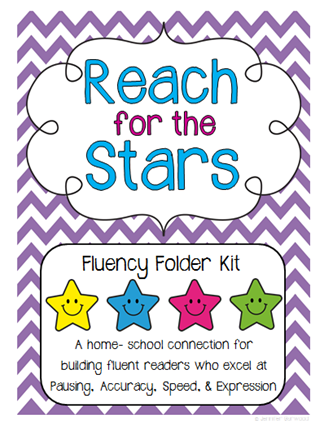
This year, I’m using my Reach for the Stars fluency folders with my second grade group, but honestly, I could see even my fifth graders benefitting from it if our time wasn’t already booked! The folders purposely don’t include passages, because I wanted teachers to be able to choose the passages that work for their students and differentiate as needed, and the rate graphs have five different options to work for any kids you teach!

IMG_1015

I know I am completely biased because I made these, but I love that these folders give students a focus on well-rounded fluency, while still only spending a few minutes daily on it.  The only thing that takes longer is the hot/cold reads on Monday and Friday, but in the past I’ve had parent volunteers help or had the students time each other in partners (so my pack includes clear directions for adults or kids!).

IMG_1029

These fluency folders are brand new to my store, but I’ve been using most of the elements for 5 or 6 weeks now, and they are such a great solution for fitting fluency instruction into my students’ day! They include everything you need for setting up homework folders (which could also be used in the classroom with partners), everything you need to record your students’ progress, and materials and lesson ideas for teaching what fluency is.

If you liked the Four Star Fluency bookmarks, you can grab them in black and white AND in color for FREE just by downloading the file preview here:

image

http://www.teacherspayteachers.com/Product/Reach-for-the-Stars-Fluency-Folder-928567

This product is on sale until tomorrow (Thursday, 10/17/13) at midnight—so I hope you’ll check it out if you think it might work for your kids! :)

Tuesday, October 1, 2013

Currently October- and one of my favorite things :)

Fall sure flies when you're a teacher. I missed last month's Currently with Farley at Oh Boy Fourth Grade, so I wanted to make sure I caught October's!


This month's going to be a little different for me. I'm still settling into a new area and don't know many people, which hasn't been so bad so far...  but now my husband's switching to 2nd shift, which means that if I'm spending a lot more time home alone. So far, I'm not loving it.

We do have plans every weekend this month, including a surprise mini-vacation for our dating anniversary at the end of the month. He won't tell me yet where we're going, but I am so excited!

As for my "treat"... I highly suggest the Lemon Escape lotion from VS! It makes me smell just like a lemon Starburst and I am in LOVE!


post signature

Monday, September 30, 2013

Classroom Tour as a Reading Specialist

I’m pretty late on this one, but I wanted to share with you my new classroom. I’m a reading specialist this year, sharing the “Reading Center” space with two other talented teachers. (One is our Title I teacher and the other is a reading specialist who works half-time at our school and half-time at another elementary in the district.)

IMG_0395

Here’s the sign I made for outside our room. I love the little computer and books, but I designed the sign and glued everything down before realizing it wouldn’t fit in our laminator. Oops—not quite even anymore!

IMG_0399

Our room is a former band room and has been split into 3 spaces- the Title I “room,” the Math Lab, and the space for our 2 reading specialists to share in the back. On the side, stretching across all 3 spaces, we have a leveled library.

IMG_0401

Here’s where I spend most of my mornings! My co-reading specialist takes it over in the afternoon. She was hired before me and did most of the decorating in here, but she’s let me bring in lots of my things, too! I love that we have so many different spaces.

IMG_0434

I love our bright windows! We have computers alongside the carpet/ easel space, and my co-worker brought in a curtain to add a little bit of homey-ness to the window area.

IMG_0437

I am loving the CRAFT board from Ladybug’s Teacher Files in our teaching area! Rather than using cards this year, we are just writing the strategies with dry-erase marker.

IMG_0428

We have a little reading area with my umbrella and comfy seats.

IMG_0403

We have another table for when we need to do assessments and have a second workspace, along with our shelves of books and book boxes.

IMG_0438

I love IKEA book boxes. Since our RTI groups can change as frequently as every 6 weeks, we’re using Super Sticky Post-Its to label them.

IMG_0425

The one thing I don’t love about our space is that I don’t really have a desk area. I am not a super-organized person, and I feel like I have a lot of “stuff” I need access to and there’s no place to put it! It’s hard for me to use our small group table as my “home base” because my partner and I both use that area to teach, so I’m using this little space at the end of our computer table.

IMG_0383

Most days, I leave out my teacher binder with custom lesson plans made in Word (yup, still loving them as much as ever!). Remember, if you haven’t, you can pick up a copy of the free lesson plan template and you can find lots of tips for customizing it!

IMG_0390

I have a little basket for my essentials, plus just enough space for my student and planning files and the books I’m LOVING this year.

IMG_0391

(I highly recommend The Next Step in Guided Reading especially for anyone using guided reading in the upper grades, and its video lessons, too! I’m also using Phonics A-Z and Words Their Way pretty frequently, especially with my younger groups.)

I’m also using the windowsill to hold my binders- what teacher can get enough binders? :)

IMG_0386

We do have FOUR of these in our side of the room as well for storage (although two are full of supplies the school owns and one is holding my coworker’s things, which is why my home is still full of boxes- ugh!)

IMG_0435

All in all, I’m getting settled in at my new school and in my new position. I am lucky to be working with two other great teachers on my team, and many others in my school, and just plain lucky to be working!

That said… THANK YOU for supporting my blog (and in some cases, my TpT store). You are an extra blessing to me as I just work half-time this year and miss having my own class!

P.S.—I have a BIG new fluency product that’s almost ready to go out… make sure you’ve followed my Facebook page and store for updates (and a chance to win it for free!)

Monday, September 16, 2013

Positive Points Monday!

This time of the year, it is so easy for teachers to get overwhelmed! Setting up classroom management routines, meeting a new class, and all of the craziness that is the beginning of the school year is hard enough, but almost every teacher I know is implementing at least one MAJOR new thing (curriculum materials, standards, tests, evaluation systems… or all of the above!). I bet a lot of you, like me, are starting a new position at a new school- and that means a lot of change! (If you’re a new teacher, there’s even MORE!)

My friend Sarah at Permanently Primary is on a mission to combat the negativity with a Positive Points link-up. I LOVE this idea- I’m an optimist at heart and I think paying attention to the positives really makes a difference in your happiness!

And Monday is the PERFECT time for some positivity, right?

  1. I got my first paycheck at my new job!
  2. In my new position, I don’t have to bring grading home.
  3. The Packers won last night! (SO happy it’s football season again.)
  4. I get to work with 2nd graders again! I’d forgotten how much fun the younger kids can be—one interrupted my lesson the other day to ask if he could just stay with me all day. Can’t get mad at him for interrupting when THAT’s the reason :)
  5. With moving out of state, I was worried it might take me awhile to make new friends here, but last week I met up with Emily from Curious Firsties. We went to an educator expo at the zoo, ate delicious food (including yummy cookies), and then browsed through children’s books at a bookstore. Perfect teacher-friend night!
  6. I am almost done with my F&P assessments!
  7. My husband and I are very good friends with a couple who just announced they’re having a baby, and I am so excited for them! A couple of my other friends have recently bought houses or adopted new doggies, too- just makes me so happy!
  8. My 5th grade group is answering questions in complete sentences! YES! (I used my Turning The Question Around pack with them and it’s paying off!)

What good things are happening in your life right now? If you blog, link up with Sarah. If not, please share in the comments or on our Facebook page.